
Aramaic Alphabet
Aramaic Alphabet is made and published by Ethan Hartzell. AppBrain is an independent app data site and isn't affiliated with Ethan Hartzell. The app name, icon, screenshots and description belong to Ethan Hartzell and are shown as published on the App Store.
AppBrain's verdict
- Rating on App Store
- 4.20
- 5 ratings
- Last updated
- March 15, 2023
It doesn't have enough ratings yet to judge what users think.
Rankings
App Store top chartsApp Store Rankings for Aramaic Alphabet
Competitors
Similar apps and more from Ethan HartzellAlternatives to Aramaic Alphabet




More from Ethan Hartzell






Releases
Updates seen on the App Store- Version
- 1.04
- Launched
- March 2023
No changelog data
User feedback
Ratings and reviews on the App StoreComments on Aramaic Alphabet for iOS
We don't have enough comments to show example comments. Please check back later.
Technology
Found in the app by AppBrain- Price
- Free
- App size
- 12.1 MB
- Content rating
- Everyone
Technologies used by Aramaic Alphabet
About the app and developer
About Aramaic Alphabet
Aramaic Alphabet is an education app developed by Ethan Hartzell.
User Ratings
Aramaic Alphabet is rated 4.20 out of 5 stars. The rating is based on 5 ratings.
App Information
Aramaic Alphabet is freely available from the App Store. The app size is 12.13 MB. The latest version available is 1.04. The last update was on March 15, 2023.
Technical Requirements
The app has a content rating of Everyone. The app has been available on the App Store since March 2023.
Developer information for Ethan Hartzell
Address:
Store listing
By Ethan Hartzell, from the App Store

Description by Ethan Hartzell Written by the developer, not by AppBrain. Click to read.
This writing system was adapted by the Arameans from Phonoecian in the 8th Century BC.
Note it is written right-to-left, like most other Semitic writing systems. That is why the first letter is listed on the top right and they go right to left, up to down from Alaph to Taw.
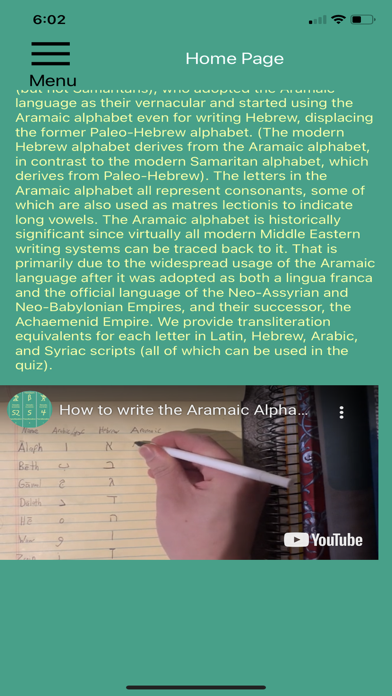
It was used to write the Aramaic languages spoken by ancient Aramean pre-Christian tribes throughout the Fertile Crescent. It was also adopted by other peoples as their own alphabet when empires and their subjects underwent linguistic Aramaization during a language shift for governing purposes—a precursor to Arabization centuries later—including among Assyrians who permanently replaced their Akkadian language and its cuneiform script with Aramaic and its script, and among Jews (but not Samaritans), who adopted the Aramaic language as their vernacular and started using the Aramaic alphabet even for writing Hebrew, displacing the former Paleo-Hebrew alphabet. (The modern Hebrew alphabet derives from the Aramaic alphabet, in contrast to the modern Samaritan alphabet, which derives from Paleo-Hebrew). The letters in the Aramaic alphabet all represent consonants, some of which are also used as matres lectionis to indicate long vowels.
The Aramaic alphabet is historically significant since virtually all modern Middle Eastern writing systems can be traced back to it. That is primarily due to the widespread usage of the Aramaic language after it was adopted as both a lingua franca and the official language of the Neo-Assyrian and Neo-Babylonian Empires, and their successor, the Achaemenid Empire.
We provide transliteration equivalents for each letter in Latin, Hebrew, Arabic, and Syriac scripts (all of which can be used in the quiz).