

AstroGauge
AstroGauge is made and published by Ancil Maxwell Hoffman. AppBrain is an independent app data site and isn't affiliated with Ancil Maxwell Hoffman. The app name, icon, screenshots and description belong to Ancil Maxwell Hoffman and are shown as published on the App Store.
AppBrain's verdict
- Last updated
- October 26, 2026
Rankings
App Store top chartsApp Store Rankings for AstroGauge
Competitors
Similar apps and more from Ancil Maxwell HoffmanMore from Ancil Maxwell Hoffman

Releases
Updates seen on the App Store- Version
- 1.0
- Launched
- October 2026
No changelog data
User feedback
Ratings and reviews on the App StoreComments on AstroGauge for iOS
We don't have enough comments to show example comments. Please check back later.
Technology
Found in the app by AppBrain- Price
- Free
- App size
- 31.6 MB
- Content rating
- Everyone
Technologies used by AstroGauge
About the app and developer
About AstroGauge
AstroGauge is a photo & video app developed by Ancil Maxwell Hoffman.
User Ratings
The app has no ratings yet.
App Information
AstroGauge is freely available from the App Store. The app size is 31.63 MB. The latest version available is 1.0. The last update was on October 26, 2026.
Technical Requirements
The app has a content rating of Everyone. The app has been available on the App Store since October 2026.
Developer information for Ancil Maxwell Hoffman
Address:
Frequently asked questions about AstroGauge
Is AstroGauge free?
Yes. AstroGauge is free on the App Store.
Is AstroGauge still available?
Yes. AstroGauge is on the App Store, and the last update we saw was on October 26, 2026.
How large is AstroGauge?
AstroGauge is 31.63 MB.
Is AstroGauge suitable for children?
App Store rates the content of AstroGauge as suitable for everyone.
Who made AstroGauge?
AstroGauge was developed by Ancil Maxwell Hoffman. It is listed in the photo & video category on the App Store.
Store listing
By Ancil Maxwell Hoffman, from the App Store


Description by Ancil Maxwell Hoffman Written by the developer, not by AppBrain. Click to read.
READ YOUR SKY
Follow the Moon, Galactic core and a visible region of the Milky Way through the night. Choose Cartesian or polar graphs, change their axes, and show the complete calculated paths or only the portions above the horizon. Compass following turns supported views with your true-north heading.
FIND YOUR NIGHT
Zoom continuously between a single night and a calendar of nights. Set your own ranges for Moon illumination, Moon position, Galactic core visibility and cloud cover. Ratings show how much of astronomical dusk to dawn meets your conditions. Missing or stale information stays unknown.
TONIGHT AT A GLANCE
Check dark-sky duration, Moon illumination and position, cloud cover, and Milky Way bearings. Expand the sheet to inspect conditions through the night. Save shooting locations, compare dates and manage observing alerts.
CHOOSE YOUR GRAPH
Use lines or pills, measured radial axes or separated rings. Adjust the circle opening, time range, markers and individual source paths. Add a sky map, compass or Moon phase in the centre when the opening is 90 degrees or less.
ON YOUR WRIST
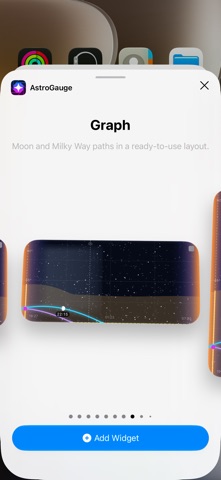
The Watch app shows one selected night. Tap the date below the graph to choose another day, use the arrows to browse, or switch compass following with the top-left symbol. Scroll for conditions, sky positions and weather details. Choose ready-to-use full-circle, half-circle or Cartesian widgets, or a customizable version of each. Widget orientation is fixed; refresh timing is managed by the system.
ASTRONOMY OFFLINE
Sky positions are calculated on your device using your current or last saved location. The Watch can calculate without an active iPhone connection. A clearly labelled sample sky lets you explore without location permission. No account or purchase is required.
Cloud forecasts use Apple Weather and require an internet connection. Widgets can show the app's last forecast for the same location. Terrain information is optional and may be unavailable. Moon glow and twilight colors are illustrations, not measurements of sky brightness. Calculated bearings do not account for every local obstruction, light pollution or photographic exposure.