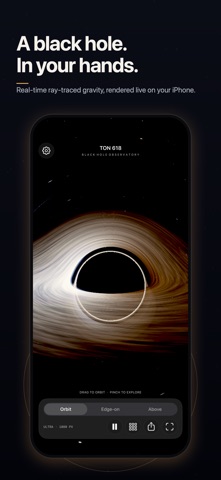
Orbit a supermassive black hole, rendered live by your iPhone's GPU — then spin it, fall into it, and see it as the Event Horizon Telescope would.
This is not a video. Every frame traces light through curved spacetime along exact geodesics — Schwarzschild's for a still black hole, Kerr's for a spinning one — so what you see is what general relativity predicts: the accretion disk bent up and over the shadow, the thin photon ring, and, as the hole spins, a shadow that slides sideways and flattens.
SPIN IT
Turn the spin from zero to 0.998, the most a real black hole can manage. Space is dragged round with it, the disk reaches in toward the horizon, and the shadow takes its famous D shape.
DIVE IN
Let go and fall. The sky ahead turns blue and bright, the sky behind reddens, and the shadow swallows the view. Your clock and a distant one keep count, and the rate between them climbs without limit — and at a black hole as big as TON 618 you cross the horizon without feeling a thing. Inside a non-spinning hole the camera follows you nearly to the centre. When it is over, a fall report puts the two clocks side by side and shows what time relativity really costs: falling, the outside barely ages; holding still at a metre from the horizon, an hour of yours is centuries of theirs.
SPAGHETTIFY
Drop yourself, an asteroid, Earth or the Sun into a black hole and watch the tide pull it apart, in the faller's own frame with the real clocks. A small black hole shreds you far outside its horizon; a huge one like TON 618 lets you cross it whole and tears you apart only inside.
SIX REAL BLACK HOLES
TON 618, M87*, Sagittarius A*, Cygnus X-1, Gaia BH1 and GW150914 — each with its real mass, spin, distance and story, and the angle we see it from on Earth.
THE TELESCOPE VIEW
The same light as the Event Horizon Telescope would see it, at each hole's true size on the sky: M87* and Sagittarius A* as glowing rings, and TON 618, too far away, as a blur.
LIGHT PATHS
Watch a sheet of light meet the hole: the wavefront bends, slows, and freezes at the horizon. The horizon, ergosphere, light orbits and innermost stable orbit are drawn to scale.
READOUTS
Distance, time dilation, orbital speed, the tides across your body and the escape speed — in real units for the black hole on show.
JETS
Beams of particles fired along the spin axis, powered by the spin itself and brightest where they come toward you.
EXPLORE
Drag to orbit, pinch to fly closer, double-tap to reset. Three framings — Orbit, Edge-on and Above — or find your own angle. Three looks: Realistic, Anime, and Telescope. Turn on the grid to watch space itself dip toward the horizon. Everything else lives in the Explore bay: swipe up from its tab.
TUNED FOR YOUR DEVICE
Three quality tiers — Saver, Balanced and Ultra — each a ceiling: frames come at 30 a second, or 60 on Balanced and Ultra when your phone has room, and the picture draws a little less on its own when it warms up or Low Power Mode is on. The app offers a cooler tier if it gets hot.
QUIET BY DESIGN
Music, or custom sounds made live from the physics on screen (no recordings) — your choice in Settings — that respect your silent switch. Spacecraft models are NASA preview renders; the app is not endorsed by NASA. No account, no sign-in, no subscription. The app is free. Changing the picture quality shows a short ad, and Ultra is unlocked by watching a short video. In the Spaghettify lab, the astronaut, the little helicopter and an asteroid are always free; the spacecraft, Earth and the Sun open for a day after a short video, and an ad plays every few falls.
THE MODEL
Light follows exact null geodesics of the Schwarzschild and Kerr spacetimes, in units of each hole's mass. Disk colours and brightness and the photon ring are styled for clarity, and the drawn disk reaches a little inside the innermost stable orbit — a visualisation, not a resolved observation.
Show more
Show less