

Chess Strategy & Tactics Vol 1
Chess Strategy & Tactics Vol 1 is made and published by Chess King. AppBrain is an independent app data site and isn't affiliated with Chess King. The app name, icon, screenshots and description belong to Chess King and are shown as published on the App Store.
AppBrain's verdict
Established- Rating on App Store
- 4.69
- 98 ratings
- Last updated
- December 28, 2017
It doesn't have enough ratings yet to judge what users think.
Rankings
App Store top chartsApp Store Rankings for Chess Strategy & Tactics Vol 1
Competitors
Similar apps and more from Chess KingAlternatives to Chess Strategy & Tactics Vol 1





More from Chess King







Releases
Updates seen on the App Store- Version
- 1.2
- Launched
- September 2016
No changelog data
User feedback
Ratings and reviews on the App StoreComments on Chess Strategy & Tactics Vol 1 for iOS
We don't have enough comments to show example comments. Please check back later.
Technology
Found in the app by AppBrain- Price
- Free
- App size
- 43.9 MB
- Content rating
- Everyone
Technologies used by Chess Strategy & Tactics Vol 1
About the app and developer
About Chess Strategy & Tactics Vol 1
Chess Strategy & Tactics Vol 1 is a games app developed by Chess King.
User Ratings
Chess Strategy & Tactics Vol 1 is rated 4.69 out of 5 stars. The rating is based on 98 ratings.
App Information
Chess Strategy & Tactics Vol 1 is freely available from the App Store. The app size is 43.94 MB. The latest version available is 1.2. The last update was on December 28, 2017.
Technical Requirements
The app has a content rating of Everyone. The app has been available on the App Store since September 2016.
Developer information for Chess King
Address:
Frequently asked questions about Chess Strategy & Tactics Vol 1
Is Chess Strategy & Tactics Vol 1 free?
Yes. Chess Strategy & Tactics Vol 1 is free on the App Store.
Is Chess Strategy & Tactics Vol 1 still available?
Yes. Chess Strategy & Tactics Vol 1 is on the App Store, and the last update we saw was on December 28, 2017.
How large is Chess Strategy & Tactics Vol 1?
Chess Strategy & Tactics Vol 1 is 43.94 MB.
Is Chess Strategy & Tactics Vol 1 suitable for children?
App Store rates the content of Chess Strategy & Tactics Vol 1 as suitable for everyone.
How do people rate Chess Strategy & Tactics Vol 1?
Chess Strategy & Tactics Vol 1 scores 4.69 out of 5 stars, from 98 ratings on the App Store.
Who made Chess Strategy & Tactics Vol 1?
Chess Strategy & Tactics Vol 1 was developed by Chess King. It is listed in the games category on the App Store.
What are the best alternatives to Chess Strategy & Tactics Vol 1?
People looking at Chess Strategy & Tactics Vol 1 also look at these games apps: Chess Opening Trainer, Chess puzzles kids & beginners, Chess Opener Lite, Chess Endgame Trainer, Chessvis.
Store listing
By Chess King, from the App Store


Description by Chess King Written by the developer, not by AppBrain. Click to read.
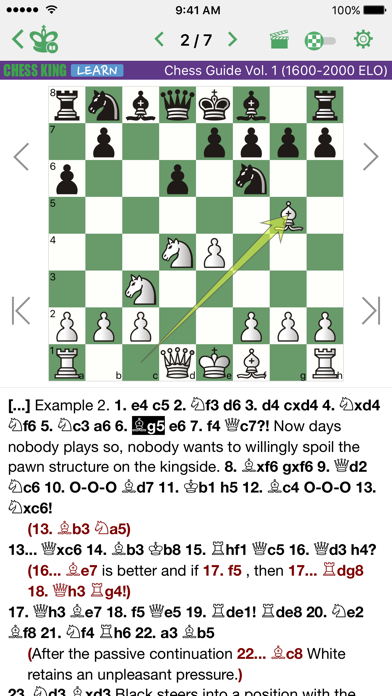
This course is in the series Chess King Learn, which is an unprecedented chess teaching method. In the series are included courses in tactics, strategy, openings, middle game, and endgame, split by levels from beginners to experienced players, and even professional players.
With the help of this course, you can improve your chess knowledge, learn new tactical tricks and combinations, and consolidate the acquired knowledge into practice.
The program acts as a coach who gives tasks to solve and helps to solve them if you get stuck. It will give you hints, explanations and show you even striking refutation of the mistakes you might make.
The program also contains a theoretical section, which explains the methods of the game in a certain stage of the game, based on actual examples. The theory is presented in an interactive way, which means you can not only read the text of the lessons, but also to make moves on the board and work out unclear moves on the board.
Advantages of the program:
• High quality examples, all double-checked for correctness
• You need to enter all key moves, required by the teacher
• Different levels of complexity of the tasks
• Various goals, which need to be reached in the problems
• The program gives hint if an error is made
• For typical mistaken moves, the refutation is shown
• You can play out any position of the tasks against the computer
• Interactive theoretical lessons
• Structured table of contents
• The program monitors the change in the rating (ELO) of the player during the learning process
• Test mode with flexible settings
• Possibility to bookmark favorite exercises
• The application is adapted to the bigger screen of a tablet
• The application does not require an internet connection
The course includes a free part, in which you can test the program. Lessons offered in the free version is fully functional. They allow you to test the application in real world conditions before releasing the following topics:
1. Attacking the king in the center
2. Attacking the king when both sides castle to the same flank
3. Attacking the king
4. The calculation mistakes
5. Training the technique of calculation
6. The "good" and the "bad" bishops
7. The bishop is stronger than the knight
8. The knight is stronger than the bishop
9. The bishops of opposite color in the middlegame
10. Bringing a piece out of play
11. Exploiting the open and semi-open files
12. Open and semi-open files and attacking the king
13. An outpost on an open or semi-open file
14. Fighting for an open file
15. Strong pawn center
16. Undermining the pawn center
17. Pieces against the pawn center
18. Pieces and pawns in the center
19. The center's role in flank operations
20. Two bishops in the middlegame
21. Two bishops in the endgame
22. Successful struggle against a bishop pair
23. The weak points in opponent's camp
24. The weakness of a complex of squares
25. About some strong points
26. The pawn weaknesses
27. The doubled pawns
28. A retarded pawn on a semi-open file
29. A passed pawn
30. Queen vs. two rooks
31. Queen vs. Rook and a minor piece
32. The queen vs. the three minor pieces
33. Compensation for the queen
34. Two rooks vs. three minor pieces
35. Two minor pieces vs. Rook (with pawns)
36. The rook vs. the minor piece and two pawns
37. Compensation for the rook
38. The minor piece vs. the three pawns
39. Compensation for a minor piece
40. The learning positions