

CINE WHITE BALANCE
CINE WHITE BALANCE is made and published by KARL HENRY WEINREICH III. AppBrain is an independent app data site and isn't affiliated with KARL HENRY WEINREICH III. The app name, icon, screenshots and description belong to KARL HENRY WEINREICH III and are shown as published on the App Store.
AppBrain's verdict
- Rating on App Store
- 5.00
- 4 ratings
- Last updated
- October 7, 2026
It doesn't have enough ratings yet to judge what users think.
Rankings
App Store top chartsApp Store Rankings for CINE WHITE BALANCE
Releases
Updates seen on the App Store- Version
- 5.2
- Launched
- December 2025
No changelog data
User feedback
Ratings and reviews on the App StoreComments on CINE WHITE BALANCE for iOS
We don't have enough comments to show example comments. Please check back later.
Technology
Found in the app by AppBrain- Price
- $9.99
- App size
- 3.71 MB
- Content rating
- Everyone
Technologies used by CINE WHITE BALANCE
About the app and developer
About CINE WHITE BALANCE
CINE WHITE BALANCE is a photo & video app developed by KARL HENRY WEINREICH III.
User Ratings
CINE WHITE BALANCE is rated 5.00 out of 5 stars. The rating is based on 4 ratings.
App Information
CINE WHITE BALANCE costs $9.99. The app size is 3.71 MB. The latest version available is 5.2. The last update was on October 7, 2026.
Technical Requirements
The app has a content rating of Everyone. The app has been available on the App Store since December 2025.
Developer information for KARL HENRY WEINREICH III
Address:
Store listing
By KARL HENRY WEINREICH III, from the App Store


Description by KARL HENRY WEINREICH III Written by the developer, not by AppBrain. Click to read.
Point the phone at the light. It reads a color temperature and a tint, then translates that one measurement into what your body actually asks for — in its own wording, in its own step size. An ALEXA wants a tint value. A VENICE wants something else. A LUMIX calls it something else again. You get the number to dial, not a conversion to do in your head.
DIRECTOR'S VIEWFINDER
Pick a body, its shooting mode and a lens set, and the live picture shows what that combination would see. The frame is the sensor's native shape and it holds still — changing lenses moves the picture behind it, because the phone ramps its own zoom so a 24 pulls out and a 135 pushes in, the way swapping glass would.
• 81 bodies, 124 imaging modes, 103 lens series — ARRI, RED, Sony, Canon, Blackmagic, Panasonic, Fujifilm, Nikon, Leica, Z CAM, cine and stills glass
• Framelines for your delivery crop, with the surround shaded as much or as little as you like
• Prime turrets and zoom barrels stepped through real focal marks, naming the lens you are on
• Mount adapters, speed boosters, extenders and anamorphic squeeze
• AE lock, an exposure trim, a luminance histogram, and a three-way ASC CDL grade previsualised over the live picture
• Capture stills or walkthrough clips, with the camera, lens, frame, angles of view, white balance and place burned onto the frame
• Group frames by job and send a shotlist PDF
THE METER
• 19 camera families, each with its own translation and its own step size
• Spot or full-frame metering, with a reticle you place by tapping
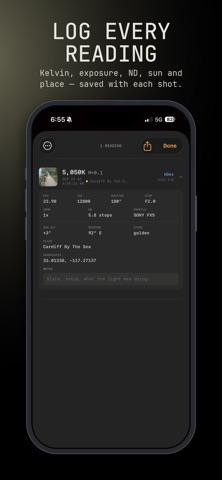
• Lock a reading as an anchor and see everything else as a difference from it — how you match a second setup to the first, or catch the light drifting after lunch
• Calibrate the tint scale to your own body, once
LIGHT YOU HAVE NOT MET YET
• Sun tracker: the sun's whole path for any date and place, drawn over the live picture
• Predicted colour: what the light will be where you are going, with cloud cover from the forecast — and a badge saying how far to trust the figure
• The day: every reading you pinned, plotted against night, blue hour, golden hour and full sun
GELS, ND AND FRAMING
• CORRECT takes a source to a target, names the LEE or Rosco gel that gets closest, what you actually land on, and what it costs you in stops
• MATCH makes two sources agree
• An ND calculator, and a density-to-stops table for when somebody calls a filter by the other name
• Delivery ratios, the pixel dimensions to set a timeline to, what a resolution somebody handed you actually is, and the custom marker number your monitor asks for
WHAT LEAVES THE PHONE IS YOURS
Scenes export as CSV for the editor or PDF for the gaffer. Frames export as a shotlist. Place names and coordinates can be kept out of all of it.
One payment. No subscription, no account, no ads. Nothing is uploaded except the coordinate used to fetch a cloud-cover forecast, when you ask for one.
A phone is not a spectrometer. Under a narrow-band source the app says so rather than pretending otherwise, and every predicted figure carries the basis it rests on.