

Continuum: Consistency Tracker
Continuum: Consistency Tracker is made and published by Ryan Frigo. AppBrain is an independent app data site and isn't affiliated with Ryan Frigo. The app name, icon, screenshots and description belong to Ryan Frigo and are shown as published on the App Store.
AppBrain's verdict
- Rating on App Store
- 5.00
- 6 ratings
- Last updated
- October 13, 2026
It doesn't have enough ratings yet to judge what users think.
Rankings
App Store top chartsApp Store Rankings for Continuum: Consistency Tracker
Releases
Updates seen on the App Store- Version
- 3.8.1
- Launched
- October 2025
No changelog data
User feedback
Ratings and reviews on the App StoreComments on Continuum: Consistency Tracker for iOS
We don't have enough comments to show example comments. Please check back later.
Technology
Found in the app by AppBrain- Price
- Free
- App size
- 2.47 MB
- Content rating
- Everyone
Technologies used by Continuum: Consistency Tracker
About the app and developer
About Continuum: Consistency Tracker
Continuum: Consistency Tracker is a productivity app developed by Ryan Frigo.
What is the rating of Continuum: Consistency Tracker?
Continuum: Consistency Tracker is rated 5.00 out of 5 stars, based on 6 ratings.
Is Continuum: Consistency Tracker free?
Continuum: Consistency Tracker is free. The app size is 2.47 MB. The latest version available is 3.8.1. The last update was on October 13, 2026.
What are the requirements for Continuum: Consistency Tracker?
The app has a content rating of Everyone. The app has been available on the App Store since October 2025.
Developer information for Ryan Frigo
Address:
Store listing
By Ryan Frigo, from the App Store

Description by Ryan Frigo Written by the developer, not by AppBrain. Click to read.
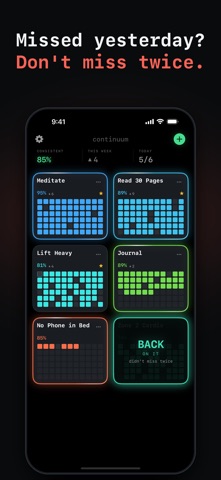
Continuum is the habit tracker for consistency, not perfection: one number per habit, the share of days you actually showed up over the last 66. It's free. There's nothing to sign up for and nothing to buy.
THE NUMBER
Streaks are brittle. One bad Tuesday and six weeks read 0, which is usually the day people quit. I built this app around streaks for a year, freezes included, and it was the wrong number to put in front of anyone who was mostly doing fine — the person who misses one Tuesday in six weeks is exactly the one a reset loses. Here a missed day is a dip: a point or two once a habit is a couple of months old, more while it's new. Show up tomorrow and it climbs back.
The count starts on your first day. A habit you began last week isn't scored against the weeks before it existed.
GETTING MORE CONSISTENT
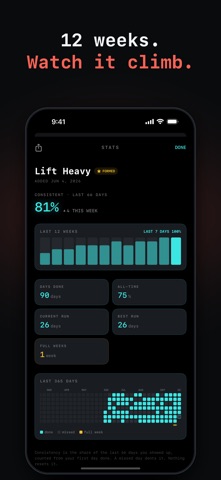
Every number has a triangle beside it: how far it moved this week. The stats screen draws your last 12 weeks as bars, one per week, so you can see whether you're getting better — which matters more than whether you're perfect, because almost nobody is.
NEVER MISS TWICE
It's James Clear's rule. Missing once is normal; the trick is not letting one miss turn into two. With reminders on, a missed day gets one quiet nudge the next evening. Mark it and the card says you're back on it.
66 DAYS, MOST OF THEM
In a UCL study (Lally et al., 2010), daily habits took a median of 66 days to become automatic — 18 for some people, 254 for others — and one missed day didn't materially slow it down. A 2024 review of 20 studies says to plan on two to five months. So a habit here is formed after 66 days with at least 80% of them done. The 80% is my line for "most days"; neither paper sets one.
THE GRID
Every habit gets a 66-day grid, one square per day. Your number is exactly the filled squares over the squares so far.
MARKING DONE
Press and hold. Haptics build under your thumb and release when the day registers (hard to do by accident). Forgot yesterday? Tap once, then hold.
WIDGETS
Home screen and lock screen, percentage included. On the home screen, mark a habit done without opening the app.
THE REST
A year heatmap per habit. Share cards. iCloud sync across your devices. Dark, monospaced, deliberately plain.
There's no social feed, and nothing resets.