

Crop: Hydroponic Calculator
Crop: Hydroponic Calculator is made and published by Roman Kopaliani. AppBrain is an independent app data site and isn't affiliated with Roman Kopaliani. The app name, icon, screenshots and description belong to Roman Kopaliani and are shown as published on the App Store.
AppBrain's verdict
- Rating on App Store
- 5.00
- 2 ratings
- Last updated
- August 15, 2026
It doesn't have enough ratings yet to judge what users think.
Rankings
App Store top chartsApp Store Rankings for Crop: Hydroponic Calculator
Competitors
Similar apps and more from Roman KopalianiAlternatives to Crop: Hydroponic Calculator


More from Roman Kopaliani


Releases
Updates seen on the App Store- Version
- 1.6
- Launched
- June 2026
No changelog data
User feedback
Ratings and reviews on the App StoreComments on Crop: Hydroponic Calculator for iOS
We don't have enough comments to show example comments. Please check back later.
Technology
Found in the app by AppBrain- Price
- Free
- App size
- 761.0 KB
- Content rating
- Everyone
Technologies used by Crop: Hydroponic Calculator
About the app and developer
About Crop: Hydroponic Calculator
Crop: Hydroponic Calculator is an utilities app developed by Roman Kopaliani.
What is the rating of Crop: Hydroponic Calculator?
Crop: Hydroponic Calculator is rated 5.00 out of 5 stars, based on 2 ratings.
Is Crop: Hydroponic Calculator free?
Crop: Hydroponic Calculator is free. The app size is 761.00 kB. The latest version available is 1.6. The last update was on August 15, 2026.
What are the requirements for Crop: Hydroponic Calculator?
The app has a content rating of Everyone. The app has been available on the App Store since June 2026.
Developer information for Roman Kopaliani
Address:
Store listing
By Roman Kopaliani, from the App Store


Description by Roman Kopaliani Written by the developer, not by AppBrain. Click to read.
WHAT'S INSIDE
• Plant + stage targets — lettuce (seedling + mature head), tomato (seedling, vegetative, fruiting), basil, leafy herbs (cilantro, parsley, mint, chives), cucumber, pepper, strawberry (fruiting), leafy greens (kale, chard, spinach, arugula), and microgreens. Lettuce, tomato, and herbs are the fully cited core; the rest is surfaced as broad guidance with explicit "per-stage tables are thinner for this crop" framing.
• Branded recipes — MasterBlend Tomato 4-18-38 (2:2:1 with calcium nitrate + Epsom), MasterBlend Lettuce 8-15-36 (the Cornell CEA leafy recipe), Jack's 3-2-1 (Jack's 5-12-26 + 15-0-0 calcium nitrate + Epsom), and the General Hydroponics Flora trio (Lite Feeding and Aggressive Leafy ratios).
• Twenty cited salts — calcium nitrate tetrahydrate, KNO₃, KH₂PO₄, K₂SO₄, MgSO₄·7H₂O, ammonium nitrate, monoammonium phosphate, magnesium nitrate, iron EDTA and DTPA, MnSO₄, ZnSO₄, CuSO₄, boric acid, sodium borate, sodium molybdate, calcium chloride, potassium chloride. Every percentage is derived from the chemical formula using IUPAC 2021 atomic weights.
• Target → salt-weight solver — the Resh / Mattson sequential satisfy textbook method. Enter your reservoir volume and a target ppm or pick a plant + stage, and Crop calculates the grams of each salt to mix.
• Reverse calculation — enter the salt weights you actually used and see the delivered ppm per element.
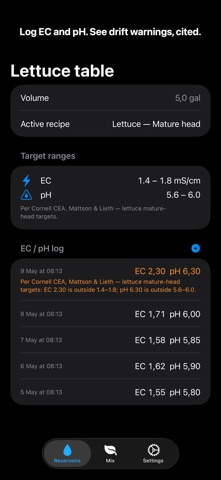
• Multi-reservoir EC + pH log — track a separate reservoir per crop or per zone, log readings over time, and surface drift warnings cited to the published source ("Per Cornell: lettuce mature 1.4–1.8 mS/cm; you logged 2.3 — dilute or top up plain water").
• Share-sheet mix sheet — export the day's reservoir target + salt weights + EC/pH range + named-source citation as plain text. Send it to yourself, paste it into your shop notebook, or print it.
• Unit flexibility — US gallons or liters, grams or ounces, EC scale 500 / 640 / 700 (matches Hanna, Bluelab, Cornell tables, or European meters).
DISCLAIMER
Crop presents Cornell CEA, Penn State Extension, UF/IFAS, and Produce Grower guidance for educational purposes. Verify recipes against current publications and your own meter readings before mixing at scale.
CITATIONS
Plant + stage recipes are sourced from Cornell CEA (Mattson & Lieth), Penn State Extension, UF/IFAS, and Produce Grower. Branded product analyses come from the manufacturer's published guaranteed-analysis labels and feeding charts. Method references are Resh, Hydroponic Food Production (7th edition), and Mattson & Lieth's hydroponic recipe calculation notes. Salt elemental percentages are derived from IUPAC 2021 atomic weights and CRC Handbook (100th edition) formula masses.
NO ACCOUNT. NO ADS. NO TRACKING. NO SUBSCRIPTIONS.
Crop does not collect any personal data. Everything stays on your device. One-time purchase, lifetime updates.