

ECG Vector is made and published by Takashi Nakano. AppBrain is an independent app data site and isn't affiliated with Takashi Nakano. The app name, icon, screenshots and description belong to Takashi Nakano and are shown as published on the App Store.
AppBrain's verdict
- Last updated
- October 16, 2026
Rankings
App Store top chartsApp Store Rankings for ECG Vector
Competitors
Similar apps and more from Takashi NakanoAlternatives to ECG Vector


More from Takashi Nakano

Releases
Updates seen on the App Store- Version
- 1.3.1
- Launched
- August 2026
No changelog data
User feedback
Ratings and reviews on the App StoreComments on ECG Vector for iOS
We don't have enough comments to show example comments. Please check back later.
Technology
Found in the app by AppBrain- Price
- Free
- App size
- 12.0 MB
- Content rating
- Everyone
Technologies used by ECG Vector
About the app and developer
About ECG Vector
ECG Vector is an education app developed by Takashi Nakano.
User Ratings
The app has no ratings yet.
App Information
ECG Vector is freely available from the App Store. The app size is 12.05 MB. The latest version available is 1.3.1. The last update was on October 16, 2026.
Technical Requirements
The app has a content rating of Everyone. The app has been available on the App Store since August 2026.
Developer information for Takashi Nakano
Address:
Frequently asked questions about ECG Vector
Is ECG Vector free?
Yes. ECG Vector is free on the App Store.
Is ECG Vector still available?
Yes. ECG Vector is on the App Store, and the last update we saw was on October 16, 2026.
How large is ECG Vector?
ECG Vector is 12.05 MB.
Is ECG Vector suitable for children?
App Store rates the content of ECG Vector as suitable for everyone.
Who made ECG Vector?
ECG Vector was developed by Takashi Nakano. It is listed in the education category on the App Store.
What are the best alternatives to ECG Vector?
People looking at ECG Vector also look at these education apps: Yomibuddy, ClinicaRN-NCLEX Prep & Sim, MoniConn EDU, VitalCore, ECG Manual Interactivo.
Store listing
By Takashi Nakano, from the App Store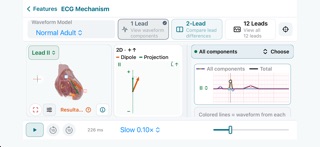




Description by Takashi Nakano Written by the developer, not by AppBrain. Click to read.
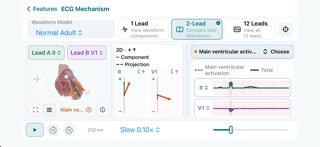
ECG Mechanism
Observe 3D activation and repolarization, the cardiac source vector, and lead-axis projections in sync with the ECG. Use single-lead decomposition, two-lead comparison, and the 12-lead view to understand differences in polarity and shape.
Ion & ECG
Explore educational approximations linking Na⁺, K⁺, Ca²⁺, H⁺ (pH), and major ion currents to action potentials, ECG measures, and clinical conditions. See differences from the reference alongside explanations.
Ventricular Action Potential
Numerically simulate a single ventricular cell using Luo–Rudy I (1991). View membrane voltage, Na⁺/Ca²⁺/K⁺ currents, conductances, and gates together. Pause at the peak sodium current and compare with the membrane diagram.
Cardiac Rhythm
View representative regional action potentials on a shared timeline. Adjust the sinus cycle, conduction speed, and AV delay, and explore schematic examples of normal rhythm, bradycardia, tachycardia, and AV block.
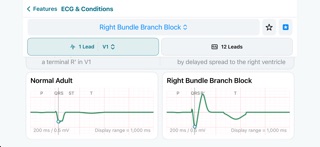
ECG & Conditions
Compare normal and representative clinical patterns in single-lead or 12-lead views, with explanations of waveform features and their mechanisms.
Learn & Quiz
Identify patterns from the 12 leads and rhythm strip, then deepen your understanding with explanations.
Free access includes Adult Normal and Right Bundle Branch Block, all standard 12 leads, fixed electrode placement, four guided Ion & ECG examples, and comparison and quiz samples. The standard ventricular-cell model, stimulus adjustment, playback, current and gate inspection, and all Cardiac Rhythm features are also free.
The one-time ECG Vector Pro purchase unlocks unrestricted Ion & ECG adjustment and its synchronized 12-lead response; ventricular-cell conductance adjustment, suppression presets, and comparison with the standard trace; additional pediatric and clinical patterns; custom leads; electrode editing; and the complete comparison and quiz libraries. This is not a subscription.
For education only—not diagnosis, treatment decisions, or patient-specific prediction. Ion & ECG uses educational response approximations; the ventricular-cell model is based on guinea-pig ventricular muscle; Cardiac Rhythm uses waveform templates and activation timings. A single-cell membrane potential is not a surface ECG or a QT interval. No sign-in or external hardware is required.