

Flower Identifier: Bloom ID
Flower Identifier: Bloom ID is made and published by Milad Atef. AppBrain is an independent app data site and isn't affiliated with Milad Atef. The app name, icon, screenshots and description belong to Milad Atef and are shown as published on the App Store.
AppBrain's verdict
- Last updated
- September 17, 2026
- Size
- 50.9 MB
User feedback
Ratings and reviews on the App StoreComments on Flower Identifier: Bloom ID for iOS
We don't have enough comments to show example comments. Please check back later.
Store listing
By Milad Atef, from the App Store



Description by Milad Atef Written by the developer, not by AppBrain. Click to read.
WHAT ONE PHOTO GIVES YOU
- The common name, and the Latin scientific name underneath it
- The bloom season of the species: spring, summer, autumn, winter or year-round
- Its botanical family, such as Rosaceae, Asteraceae or Orchidaceae
- The flower form: a solitary bloom, a composite head, a spike of small tubular flowers
- Typical color range, native range and growth habit
- Light and soil preferences, care level and USDA hardiness zone
- Which pollinators it attracts, from bumblebees to hummingbirds
- A confidence level, so you can see how sure the answer is
SPRING, SUMMER, OR YEAR-ROUND?
The bloom season leads every result, because it is the one thing the photograph in your hand cannot tell you. It is written as a season and never as a date, so it reads the same whether you garden in Oslo or in Auckland, and it describes when the species typically flowers rather than what the plant in front of you will do next. There is no calendar here and no reminders.
WILDFLOWERS, GARDEN BEDS AND CUT STEMS
Meadow and roadside wildflowers, border perennials and bulbs, roses, tulips, dahlias and irises, the blooms in a wrapped bouquet, and the tropical flowers you meet on holiday. Where a recognizable cultivar is visible it is named alongside the species. Give it an open flower to look at.
BUILT FOR THE PHOTOS YOU ACTUALLY TAKE
Half in shade, nodding in the wind, one bloom in a crowded border. When an image will not support a species-level answer, the result stops at the genus and says so instead of inventing a name. That happens often in the daisy, orchid and rose families, where cultivars are near enough identical, and it is the honest answer.
WHAT A FLOWER MEANS
Where a meaning is widely recorded, the result names it and names the tradition it comes from: the poppy of remembrance, the Victorian language of flowers, hanakotoba in Japan. Where no widespread meaning exists, the field stays empty rather than inventing one.
ASK ANYTHING
Every scan can open a thread about the flower you just identified. Ask how to tell a lily from a daylily, what soil it prefers, how long a cut stem lasts in a vase, or which bees it feeds. It stays on flowers and does not wander off topic.
YOUR COLLECTION, KEPT
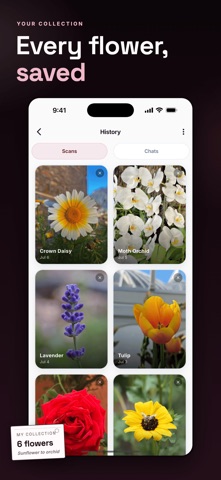
Every scan is saved on your device with its photo, so a season of walks turns into a record of what you found and when it flowers. No account.
WHO IT IS FOR
- Anyone who passed something in a park or a hedgerow and wants a name
- Gardeners working out what they inherited and when it comes into flower
- Anyone handed a bouquet who wants to know what is in it and what it has meant
- Walkers, students and botany learners who want the family, binomial and range
HONEST ABOUT WHAT A PHOTO CAN DO
An identification here is a best-effort AI suggestion, not an authoritative determination, and a cultivar reading is an estimate rather than a nursery tag. Bloom season, hardiness zone, light, soil and care level describe a species in general; they are not a plan for your own garden, and the zones are the USDA system, so the app knows nothing about your local climate. It does not diagnose plant problems or pests. Ask AI stays inside flower identification, growing and symbolism, and declines everything else.
Identifying a flower needs an internet connection. Scans you have already saved stay on your device and can be reopened at any time.
PREMIUM
Free includes 2 identifications per day. Premium removes the daily limit and opens the full detail sheet on every result. Subscriptions renew automatically unless cancelled at least 24 hours before the current period ends, and you can manage or cancel yours in your App Store account settings at any time.
Terms: https://miladapps.pro/terms
Privacy: https://miladapps.pro/privacy
Safety and technology
Found in the app by AppBrain- Price
- Free
- App size
- 50.9 MB
- Content rating
- Everyone
Technologies used by Flower Identifier: Bloom ID
Releases
Updates seen on the App Store- Version
- 1.0.7
- Launched
- June 2026
No changelog data
Alternatives
Similar apps and more from Milad AtefMore from Milad Atef


Also available on Google Play

Rankings
App Store top chartsApp Store Rankings for Flower Identifier: Bloom ID
About the app and developer
About Flower Identifier: Bloom ID
Flower Identifier: Bloom ID is a reference app developed by Milad Atef.
What is the rating of Flower Identifier: Bloom ID?
Flower Identifier: Bloom ID has no ratings yet.
Is Flower Identifier: Bloom ID free?
Flower Identifier: Bloom ID is free. The app size is 50.95 MB. The latest version available is 1.0.7. The last update was on September 17, 2026.
What are the requirements for Flower Identifier: Bloom ID?
The app has a content rating of Everyone. The app has been available on the App Store since June 2026.
Developer information for Milad Atef
Address: