

Fractal 3D
Fractal 3D is made and published by Nuclear Nova Software. AppBrain is an independent app data site and isn't affiliated with Nuclear Nova Software. The app name, icon, screenshots and description belong to Nuclear Nova Software and are shown as published on the App Store.
AppBrain's verdict
Established- Rating on App Store
- 3.00
- 4 ratings
- Last updated
- November 13, 2015
It doesn't have enough ratings yet to judge what users think.
Rankings
App Store top chartsApp Store Rankings for Fractal 3D
Competitors
Similar apps and more from Nuclear Nova SoftwareAlternatives to Fractal 3D




More from Nuclear Nova Software


Releases
Updates seen on the App Store- Version
- 1.05
- Launched
- December 2011
No changelog data
User feedback
Ratings and reviews on the App StoreComments on Fractal 3D for iOS
We don't have enough comments to show example comments. Please check back later.
Technology
Found in the app by AppBrain- Price
- $1.99
- App size
- 853.0 KB
- Content rating
- Everyone
Technologies used by Fractal 3D
About the app and developer
About Fractal 3D
Fractal 3D is an entertainment app developed by Nuclear Nova Software.
User Ratings
Fractal 3D is rated 3.00 out of 5 stars. The rating is based on 4 ratings.
App Information
Fractal 3D costs $1.99. The app size is 853.00 kB. The latest version available is 1.05. The last update was on November 13, 2015.
Technical Requirements
The app has a content rating of Everyone. The app has been available on the App Store since December 2011.
Developer information for Nuclear Nova Software
Address:
Frequently asked questions about Fractal 3D
Is Fractal 3D free?
No. Fractal 3D costs $1.99 on the App Store.
Is Fractal 3D still available?
Yes. Fractal 3D is on the App Store, and the last update we saw was on November 13, 2015.
How large is Fractal 3D?
Fractal 3D is 853.00 kB.
Is Fractal 3D suitable for children?
App Store rates the content of Fractal 3D as suitable for everyone.
How do people rate Fractal 3D?
Fractal 3D scores 3.00 out of 5 stars, from 4 ratings on the App Store.
Who made Fractal 3D?
Fractal 3D was developed by Nuclear Nova Software. It is listed in the entertainment category on the App Store.
What are the best alternatives to Fractal 3D?
People looking at Fractal 3D also look at these entertainment apps: Distorted Kaleidoscope Art, CloneFace+, Scribblify, Insanimate stunning abstract art pattern mandala, Light Creations.
Store listing
By Nuclear Nova Software, from the App Store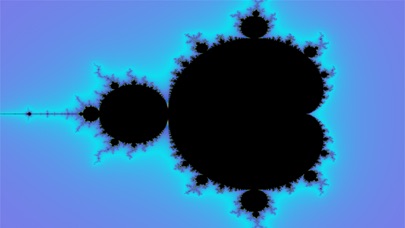
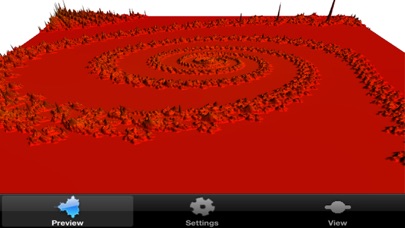
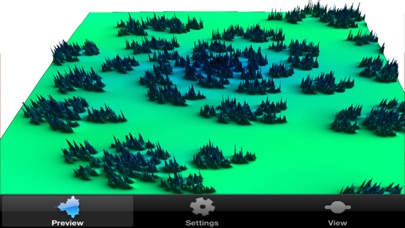
Description by Nuclear Nova Software Written by the developer, not by AppBrain. Click to read.
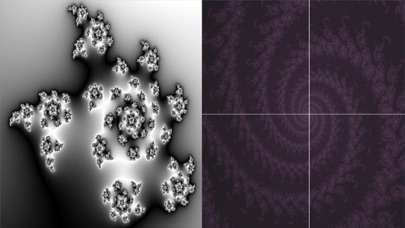
Fractal information from Wikipedia - A fractal has been defined as "a rough or fragmented geometric shape that can be split into parts, each of which is (at least approximately) a reduced-size copy of the whole," a property called self-similarity. The term fractal was coined by Benoît Mandelbrot in 1975 and was derived from the Latin frāctus meaning "broken" or "fractured." A mathematical fractal is based on an equation that undergoes iteration, a form of feedback based on recursion. There are several examples of fractals, which are defined as portraying exact self-similarity, quasi self-similarity, or statistical self-similarity. While fractals are a mathematical construct, they are found in nature, which has led to their inclusion in artwork. They are useful in medicine, soil mechanics, seismology, and technical analysis. A fractal often has the following features: It has a fine structure at arbitrarily small scales. It is too irregular to be easily described in traditional Euclidean geometric language. It has a simple and recursive definition. Because they appear similar at all levels of magnification, fractals are often considered to be infinitely complex (in informal terms). Natural objects that are approximated by fractals to a degree include clouds, mountain ranges, lightning bolts, coastlines, snow flakes, various vegetables (cauliflower and broccoli), and animal coloration patterns. However, not all self-similar objects are fractals —for example, the real line (a straight Euclidean line) is formally self-similar but fails to have other fractal characteristics; for instance, it is regular enough to be described in Euclidean terms.