

ICD10 Diseases Classifications
ICD10 Diseases Classifications is made and published by Skyscape Medpresso Inc. AppBrain is an independent app data site and isn't affiliated with Skyscape Medpresso Inc. The app name, icon, screenshots and description belong to Skyscape Medpresso Inc and are shown as published on the App Store.
AppBrain's verdict
Established- Rating on App Store
- 4.25
- 16 ratings
- Last updated
- June 24, 2026
It doesn't have enough ratings yet to judge what users think.
Rankings
App Store top chartsApp Store Rankings for ICD10 Diseases Classifications
Competitors
Similar apps and more from Skyscape Medpresso IncAlternatives to ICD10 Diseases Classifications


More from Skyscape Medpresso Inc


Also available on Google Play

Releases
Updates seen on the App Store- Version
- 5.9.2
- Launched
- March 2016
No changelog data
User feedback
Ratings and reviews on the App StoreComments on ICD10 Diseases Classifications for iOS
We don't have enough comments to show example comments. Please check back later.
Technology
Found in the app by AppBrain- Price
- Free
- App size
- 45.7 MB
- Content rating
- High
Technologies used by ICD10 Diseases Classifications
About the app and developer
About ICD10 Diseases Classifications
ICD10 Diseases Classifications is a medical app developed by Skyscape Medpresso Inc.
User Ratings
ICD10 Diseases Classifications is rated 4.25 out of 5 stars. The rating is based on 16 ratings.
App Information
ICD10 Diseases Classifications is freely available from the App Store. The app size is 45.71 MB. The latest version available is 5.9.2. The last update was on June 24, 2026.
Technical Requirements
The app has a content rating of High Maturity. The app has been available on the App Store since March 2016.
Developer information for Skyscape Medpresso Inc
Address:
Store listing
By Skyscape Medpresso Inc, from the App Store



Description by Skyscape Medpresso Inc Written by the developer, not by AppBrain. Click to read.
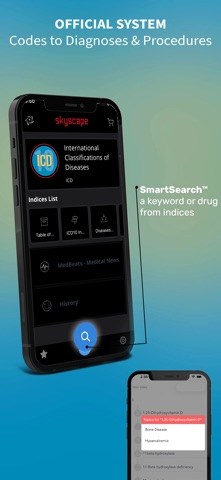
ICD-10 is the global standard for classifying diagnoses (CM) and inpatient procedures (PCS). Managed by the WHO and CMS, these alphanumeric codes provide a universal language for tracking diseases, injuries, and causes of death. They are essential for medical billing, insurance reimbursement, and health statistics. Modern updates, like those for FY 2026, focus on clinical specificity—adding detail for chronic conditions and social factors to improve patient care and data accuracy.
CDC released the FY2026 ICD-10-CM. Key Statistics for FY 2026 Updates
New Codes: 487 for Diagnosis(CM) 156 for Procedures(PCS).
Revised Codes: 38 (CM).
Deleted/Invalidated Codes: 28 (CM).
Guideline Changes: Updates to HIV, diabetes remission, social determinants of health(SDoH).
Major ICD-10-CM (Diagnosis) Changes
These changes focus on increased specificity to support value-based care and population health tracking.
Diabetes in Remission: A new code, E11.A, is used for Type 2 diabetes in remission. Providers must use the exact word “remission” for this code to be valid.
Multiple Sclerosis (MS): The general code G35 is now a parent code and no longer valid for billing. Social Determinants of Health (SDoH): Expansion of Z-codes (Z59 series) to capture factors such as financial insecurity difficulty paying for utilities.
Anatomical Specificity:
Flank Region: New codes distinguish injuries to the flank from the general abdomen.
Chronic Ulcers: Category L98 adds codes to specify laterality, severity, and exact site.
Emerging Conditions: New codes include Cannabis Hyperemesis Syndrome (R11.16) and Gulf War Illness (T75.830).
Key Features
Index of Drugs and Chemicals
-Diseases and Injuries
-External Causes of Injuries
-Neoplasm
The National Center for Health Statistics (NCHS) n Centers for Medicare and Medicaid Services oversee changes to ICD-10-CM.
Highlights-
Non-pressure ulcers include multiple new codes specifying site and severity
Updates to injuries and poisoning codes
Chapter 19 (Injury, Poisoning, and Other Consequences of External Causes) has the largest number of updates
New ICD-10 codes for neurodevelopmental disorders
Chapter 17 introduces codes for neurodevelopmental disorders related to specific genetic pathogenic variants, including ion channel, receptor-related conditions.
Updates to ICD-10 codes for diabetes
A notable addition is E11.A for Type 2 diabetes in remission, allowing documentation of patients maintaining normal blood glucose levels for three months or more.
SUBSCRIPTION :
Please choose an auto renewable subscription plan to receive content access n continuous updates. Your subscription automatically renews as per your plan, so you always have the latest content.
Six months auto-renewing payments - $ 4.99
One month auto-renewing payments - $ 1.49
Yearly auto-renewing payments- $ 7.99
Payment will be charged to your iTunes Account at confirmation of purchase. Subscription automatically renews unless auto-renew is turned off at least 24-hours before the end of the current period. Subscription may be managed by the user and auto-renewal can be disabled at any time by going to your device “Settings” and tapping “iTunes & App Store”. Any unused portion of a free trial period will be forfeited when you purchase a subscription, where applicable."
If you have any questions, email us any time: customersupport@skyscape.com or call 508-299-3000
Privacy Policy - https://www.skyscape.com/terms-of-service/privacypolicy.aspx
Terms and Conditions - https://www.skyscape.com/terms-of-service/licenseagreement.aspx
Publisher: Centers for Disease Control and Prevention