

IQ, Mental, Personality Tests
IQ, Mental, Personality Tests is made and published by Alperen Sirin. AppBrain is an independent app data site and isn't affiliated with Alperen Sirin. The app name, icon, screenshots and description belong to Alperen Sirin and are shown as published on the App Store.
AppBrain's verdict
- Rating on App Store
- 4.00
- 4 ratings
- Last updated
- August 15, 2025
It doesn't have enough ratings yet to judge what users think.
Rankings
App Store top chartsApp Store Rankings for IQ, Mental, Personality Tests
Competitors
Similar apps and more from Alperen Sirin


Releases
Updates seen on the App Store- Version
- 2.0.2
- Launched
- January 2025
No changelog data
User feedback
Ratings and reviews on the App StoreComments on IQ, Mental, Personality Tests for iOS
We don't have enough comments to show example comments. Please check back later.
Technology
Found in the app by AppBrain- Price
- Free
- App size
- 51.5 MB
- Content rating
- Everyone
Technologies used by IQ, Mental, Personality Tests
About the app and developer
About IQ, Mental, Personality Tests
IQ, Mental, Personality Tests is an education app developed by Alperen Sirin.
User Ratings
IQ, Mental, Personality Tests is rated 4.00 out of 5 stars. The rating is based on 4 ratings.
App Information
IQ, Mental, Personality Tests is freely available from the App Store. The app size is 51.45 MB. The latest version available is 2.0.2. The last update was on August 15, 2025.
Technical Requirements
The app has a content rating of Everyone. The app has been available on the App Store since January 2025.
Developer information for Alperen Sirin
Address:
Frequently asked questions about IQ, Mental, Personality Tests
Is IQ, Mental, Personality Tests free?
Yes. IQ, Mental, Personality Tests is free on the App Store.
Is IQ, Mental, Personality Tests still available?
Yes. IQ, Mental, Personality Tests is on the App Store, and the last update we saw was on August 15, 2025.
How large is IQ, Mental, Personality Tests?
IQ, Mental, Personality Tests is 51.45 MB.
Is IQ, Mental, Personality Tests suitable for children?
App Store rates the content of IQ, Mental, Personality Tests as suitable for everyone.
How do people rate IQ, Mental, Personality Tests?
IQ, Mental, Personality Tests scores 4.00 out of 5 stars, from 4 ratings on the App Store.
Who made IQ, Mental, Personality Tests?
IQ, Mental, Personality Tests was developed by Alperen Sirin. It is listed in the education category on the App Store.
What are the best alternatives to IQ, Mental, Personality Tests?
People looking at IQ, Mental, Personality Tests also look at these education apps: IQ Test - Cognitive Exam, Personality Test App, Personality & Psychology Tests, The IQ Test : Lite Edition, IQ Test - Aptitude Test.
Store listing
By Alperen Sirin, from the App Store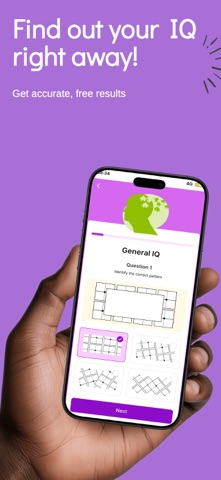
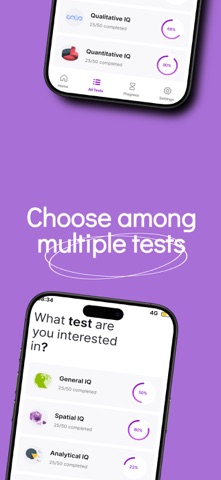
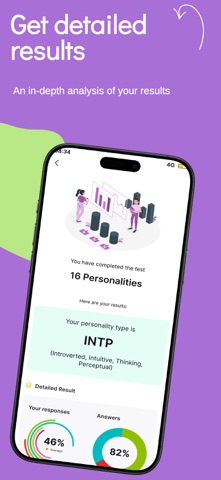


Description by Alperen Sirin Written by the developer, not by AppBrain. Click to read.
An IQ test, or Intelligence Quotient test, is a standardized assessment designed to measure human intelligence. The IQ test quantifies a person's IQ, which is a score derived from various cognitive tasks and problem-solving exercises included in the IQ test. Typically, the IQ test evaluates a range of abilities, such as logical reasoning, mathematical skills, language comprehension, and spatial visualization. The IQ score, generated from the IQ test, is used to compare the intellectual abilities of individuals within a population. Traditionally, an average IQ score from an IQ test is set at 100, with the majority of scores falling between 85 and 115. The purpose of an IQ test is to identify intellectual strengths and weaknesses, providing insight into cognitive development. In educational settings, the IQ test can help identify gifted students or those needing special education. Psychologists and researchers often utilize the IQ test in studies related to human intelligence and behavior. Critics of the IQ test argue that it may not fully encompass the complexity of human intelligence and can be influenced by socio-cultural factors. Despite these criticisms, the IQ test remains a widely recognized tool for assessing intellectual potential. There are various forms of IQ tests, including verbal, non-verbal, and performance-based assessments, each contributing to the final IQ score. The IQ test results are often used in conjunction with other evaluations to form a comprehensive understanding of an individual's cognitive abilities. While an IQ test offers valuable insights, it is important to remember that the IQ score is just one aspect of a person's intellectual profile. To get a more accurate and holistic view of intelligence, the IQ test should be considered alongside other measures of cognitive and emotional functioning. The concept of IQ and the development of the IQ test have evolved over time, reflecting changes in our understanding of intelligence. Modern adaptations of the IQ test strive to minimize cultural and linguistic biases, aiming to provide a fair assessment of an individual's intellectual capabilities. By taking an IQ test, individuals can gain a better understanding of their cognitive strengths and areas for improvement. Whether for academic, professional, or personal purposes, the IQ test serves as a valuable tool for measuring and understanding human intelligence.
The history of IQ tests dates back to the early 20th century. The concept of measuring intelligence began with Alfred Binet, a French psychologist, who, along with his colleague Théodore Simon, developed the first practical IQ test in 1905. This test was initially designed to identify children in need of special education services. The term "IQ," or Intelligence Quotient, was later coined by the German psychologist William Stern. He proposed that the IQ could be calculated by dividing a person's mental age by their chronological age and then multiplying by 100.
In the United States, psychologist Lewis Terman from Stanford University adapted Binet's work and created the Stanford-Binet IQ test in 1916, which became the standard for intelligence testing in the country. During World War I, the U.S. military used IQ tests to evaluate and classify soldiers, further popularizing the concept.
Note: The results in our application are only for entertainment and educational purposes. For true results or diagnosis, please refer to a professional. Thank you!