

Key to Insect Orders - Revised
Key to Insect Orders - Revised is made and published by LucidMobile. AppBrain is an independent app data site and isn't affiliated with LucidMobile. The app name, icon, screenshots and description belong to LucidMobile and are shown as published on the App Store.
AppBrain's verdict
- Last updated
- March 26, 2021
Rankings
App Store top chartsApp Store Rankings for Key to Insect Orders - Revised
Competitors
Similar apps and more from LucidMobileAlternatives to Key to Insect Orders - Revised


More from LucidMobile


Releases
Updates seen on the App Store- Version
- 0.2.1
- Launched
- February 2019
No changelog data
User feedback
Ratings and reviews on the App StoreComments on Key to Insect Orders - Revised for iOS
We don't have enough comments to show example comments. Please check back later.
Technology
Found in the app by AppBrain- Price
- $1.99
- App size
- 32.9 MB
- Content rating
- Everyone
Technologies used by Key to Insect Orders - Revised
About the app and developer
About Key to Insect Orders - Revised
Key to Insect Orders - Revised is a reference app developed by LucidMobile.
User Ratings
The app has no ratings yet.
App Information
Key to Insect Orders - Revised costs $1.99. The app size is 32.86 MB. The latest version available is 0.2.1. The last update was on March 26, 2021.
Technical Requirements
The app has a content rating of Everyone. The app has been available on the App Store since February 2019.
Developer information for LucidMobile
Address:
Store listing
By LucidMobile, from the App Store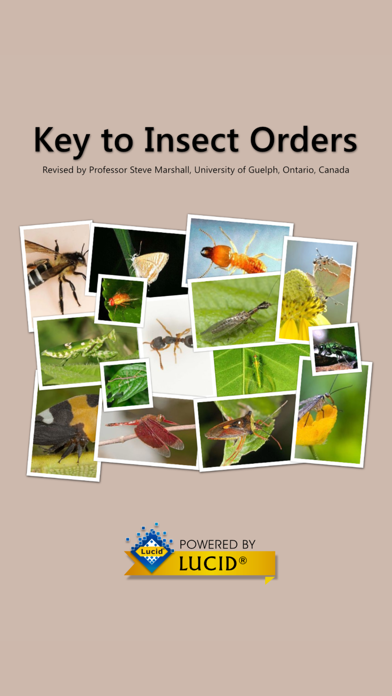
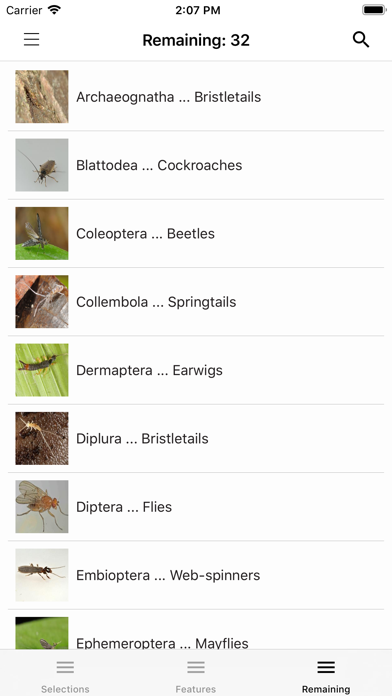
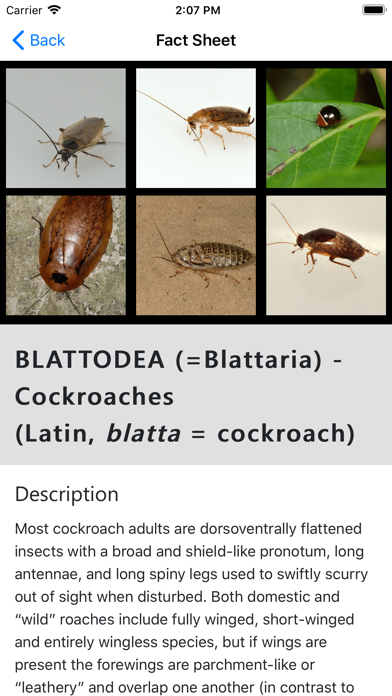
Description by LucidMobile Written by the developer, not by AppBrain. Click to read.
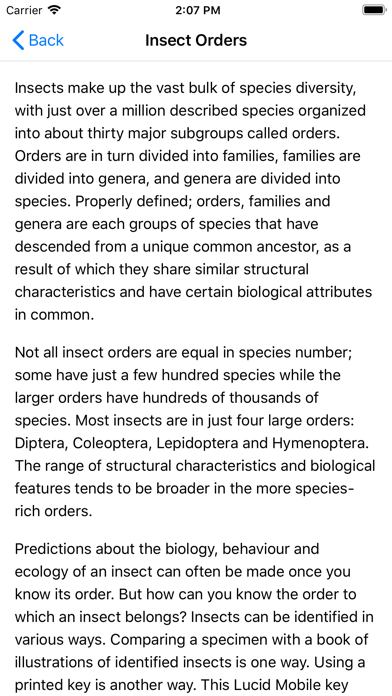
Not all insect orders are equal in species number; some have just a few hundred species while the larger orders have hundreds of thousands of species. Most insects are in just four large orders: Diptera, Coleoptera, Lepidoptera and Hymenoptera. The range of structural characteristics and biological features tends to be broader in the more species-rich orders.
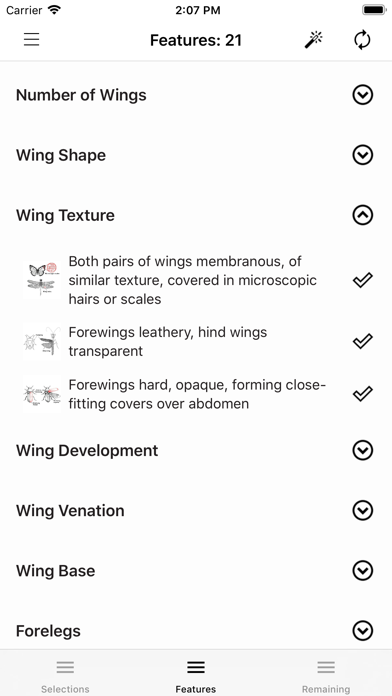
Predictions about the biology, behaviour and ecology of an insect can often be made once you know its order. But how can you know the order to which an insect belongs? Insects can be identified in various ways. Comparing a specimen with a book of illustrations of identified insects is one way. Using a printed key is another way. This Lucid Mobile key combines the advantages of these methods and adds a new dimension of simplicity and power to the process of identification.
This simple key aims to identify most common adult insects to the level of order. It has been designed for a range of users, including advanced secondary students, beginning undergraduates and others interested in entomology, and includes information about the structure and biology of insects as well as their identifying features. Three of the groups included in this key (Protura, Collembola and Diplura) are six-legged arthropods treated as insects in the vernacular sense, but now usually formally classified in their own order, outside the order Insecta.
How can you tell if an insect is an adult so it can be identified using this key? That is a simple question without a simple answer. If your insect has fully-developed, functional wings then it is an adult. However, some adult insects have reduced, non-functional wings and others have no wings at all. In these cases the adult forms have fully developed genitalia at the apex of the abdomen. Many, but not all, nymphal or immature forms are identifiable using the same features used to identify adults.
The 'Key to Insect Orders' was originally created by staff at the Department of Entomology at the University of Queensland, Brisbane, Australia (Gordon Gordh; David Yeates; Tony Young; Sue McGrath), based on the simplified keys to insect Order found in Collecting, Preserving and Classifying Insects by E.C. Dahms, G.B. Monteith and S. Monteith (Queensland Museum, 1979), Worms to Wasps by M.S. Harvey and A.L. Yen (Oxford University Press, 1989) and A Field Guide to Insects in Australia by P. Zborowski and R. Storey (Reed Books, 1995).
This new edition of Insect Orders has been revised by Professor Steve Marshall at the University of Guelph, Ontario, Canada.
This app was created using the Lucid suite of tools, for more information please visit https://www.lucidcentral.org