Every photograph LUMENKORN takes keeps its undeveloped negative. Change the film afterwards and that negative is developed again — a frame shot on black-and-white can become colour days later. An app that lays a filter over a finished JPEG cannot do this.
LUMENKORN is a 35mm film camera and a darkroom: sixteen films of its own, a development pipeline that works the way emulsion works, and the controls of a real camera body.
THE FILMS
Ten colour films and six monochromes — the names are LUMENKORN's own — each an original built from measurement: curves, colour response and grain fitted to real developed film, scanned at a photo lab. Skin sits warm and smooth without going orange. Skies come down cyan-blue with weight in them, not phone-blue. Greens go muted or go loud depending on the roll you load. Reds stay dense where a phone lets them bleed. Fast films are coarse and low in contrast; slow films are tight and steep. Every film carries honest variants (matte, pushed), a continuous printing-warmth dial for colour, a paper-grade contrast scale from 0 to 5 for black & white, and its own grain character.
DEVELOPED, NOT FILTERED
• The negative is kept in linear light and developed in a chain, in order: exposure, film curve, colour response, scan, grain, halation — the way a lab does it, not a lookup laid over a JPEG
• Highlights roll off on a film shoulder. A bright window keeps its gradation; a white shirt in sun keeps its weave
• The camera watches the live histogram and, when real area starts to clip, exposes down by up to two stops and returns them in development — a sunny sky keeps its drawing at 0 EV, and the frame still lands at the exposure you set
• Four scanner profiles decide how the negative is read: two fitted to real lab scans, one a flatbed, one a drum. Same negative, four different prints
• Grain is not noise laid on top. A synthesised emulsion sheet with a real particle-size distribution sits in the negative. It lives in the midtones and thins in the highlights, the way silver does. Zoom in and it reads like a scan, because it is built like one. Choose the 35mm negative or the quieter 120
• Halation blooms around clipped lights only — a street lamp at night gets its ring, a white wall in daylight does not
• The meter reads a third of a stop under. Digital keeps its shadows and loses its highlights — the opposite of film — so the sensor is protected at the top and the film shoulder gives the mids back in development
• Film-true white balance presets: daylight film renders golden hour golden and shade blue
• THE LAB, if you want it: automatic per-shot development that judges each frame the way a lab operator judges a roll — point, shoot, and the print comes back right
A CAMERA, NOT AN APP
• Full-resolution capture on the physical lenses — up to 48 MP, including in manual mode
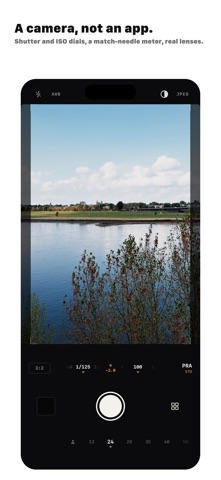
• M mode: shutter and ISO dials with a live match-needle meter; loading a film rates the meter at its box speed
• EV wheel in quarter stops, AE/AF lock, tap to meter a point
• Lenses from 13 to 200 mm that snap to the real glass
• Frames: 3:2, 4:3, 1:1, 16:9, a widescreen letterbox and a long panorama
• Every capture keeps its undeveloped negative on a roll — re-develop any photograph with a different film later, or press AUTO in the editor for a complete film reading of that image, and again for the next
• Import any photograph from your library and develop it on film — the same pipeline, the same negative kept
• A full develop kit in the editor: exposure, highlights, shadows, white balance, saturation, sharpness that can go soft, real vignetting in both directions, undo and redo
• JPEG, HEIF, or PRO: the developed photo and the untouched ProRAW original in one Photos asset
• Camera Control and Lock Screen capture, volume-button shutter, level, grid, live histogram
NOTHING LEAVES YOUR PHONE
No account, no tracking, no network access at all. Your photographs are yours.
Show more
Show less