

Math - Scientific Calculator
Math - Scientific Calculator is made and published by Saqib Masood. AppBrain is an independent app data site and isn't affiliated with Saqib Masood. The app name, icon, screenshots and description belong to Saqib Masood and are shown as published on the App Store.
AppBrain's verdict
- Last updated
- September 15, 2025
Rankings
App Store top chartsApp Store Rankings for Math - Scientific Calculator
Competitors
Similar apps and more from Saqib Masood









Releases
Updates seen on the App Store- Version
- 2.0.5
- Launched
- January 2022
No changelog data
User feedback
Ratings and reviews on the App StoreComments on Math - Scientific Calculator for iOS
We don't have enough comments to show example comments. Please check back later.
Technology
Found in the app by AppBrain- Price
- $1.99
- App size
- 28.4 MB
- Content rating
- High
Technologies used by Math - Scientific Calculator
About the app and developer
About Math - Scientific Calculator
Math - Scientific Calculator is an education app developed by Saqib Masood.
User Ratings
The app has no ratings yet.
App Information
Math - Scientific Calculator costs $1.99. The app size is 28.45 MB. The latest version available is 2.0.5. The last update was on September 15, 2025.
Technical Requirements
The app has a content rating of High Maturity. The app has been available on the App Store since January 2022.
Developer information for Saqib Masood
Address:
Store listing
By Saqib Masood, from the App Store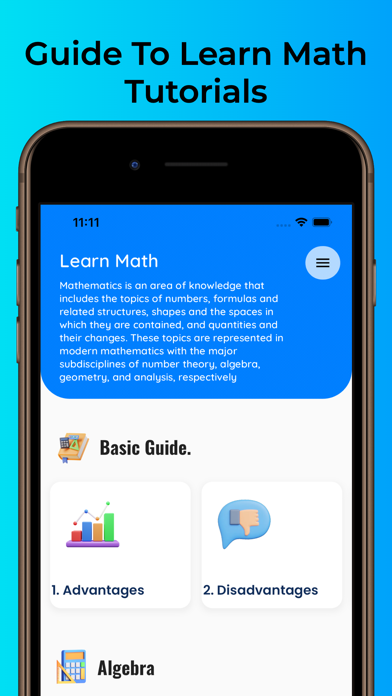



Description by Saqib Masood Written by the developer, not by AppBrain. Click to read.
Commonly, there is no accepted definition of math. Aristotle defined mathematics as, the science of quantity. The definition given by Aristotle prevailed until the 18th century.
The study of numbers, shapes, and patterns is called math. In other words, we can define the term math as, the field of study that uses numbers and symbols for measurement, properties, relationships of quantities, and sets.
According to the German philosophers Carl Friedrich Gauss, mathematics is the Queen of the Sciences.
Modern philosophers do not consider mathematics as a science because science is based on empirical observations and seek to understand some aspect of phenomena. While math defines the relationship between quantities and objects and seeks to use logic to understand. The mathematics do not relate to any phenomena.
The study of math includes the following:
Numbers: The study of numbers involves how can we count the things.
Structure: The study of structures involves how things can be organized. The subfield of structure is called algebra.
Place: The study of place involves the arrangements for the things. The subfield of place is called geometry.
Change: The study of change involves how things become different. The subfield of change is called analysis.
Why math is important?
Math is very important in our daily lives. In reality, it is implemented everywhere. It is useful for solving problems that occur in the real world. This is the reason that so many people besides mathematicians study and use mathematics. There are too many fields such as natural science, engineering, medicine, finance, etc. that uses mathematics.
There are the following reasons that makes the mathematics as a powerful tool.
Math is involved around us. So, it is an essential and powerful discipline in today's world. Our perspective of the important issues facing us as individuals, families, businesses, and nations.
It provides an effective way of building mental discipline.
It improves mental rigor for developing logical, analytical, and problem-solving skills.
The knowledge of mathematics plays a crucial role in understanding other subjects such as physics, art, music, etc.
Discrete Mathematics Tutorial
Discrete Mathematics Tutorial
Discrete mathematics Tutorial provides basic and advanced concepts of Discrete mathematics. Our Discrete mathematics Structure Tutorial is designed for beginners and professionals both.
Discrete mathematics is the branch of mathematics dealing with objects that can consider only distinct, separated values. This tutorial includes the fundamental concepts of Sets, Relations and Functions, Mathematical Logic, Group theory, Counting Theory, Probability, Mathematical Induction, and Recurrence Relations, Graph Theory, Trees and Boolean Algebra.
MathML Tutorial
MathML tutorial provides basic and advanced concepts of MathML. Our MathML tutorial is designed for beginners and professionals.
MathML is a short form of Mathematical Markup Language. It is used to describe mathematical notations.
Our MathML tutorial includes all topics of MathML language such as installation, example, basic elements, all elements, symbols, operators, subscripts, superscripts, underscript, overscript, radicals, matrices, fractions, etc.