

NETURAKU is made and published by Fuji Bit Inc. AppBrain is an independent app data site and isn't affiliated with Fuji Bit Inc. The app name, icon, screenshots and description belong to Fuji Bit Inc. and are shown as published on the App Store.
AppBrain's verdict
- Last updated
- June 7, 2026
Rankings
App Store top chartsApp Store Rankings for NETURAKU
This app is not ranked
Competitors
Similar apps and more from Fuji Bit Inc.


Releases
Updates seen on the App Store- Version
- 5.0
- Launched
- March 2026
No changelog data
User feedback
Ratings and reviews on the App StoreComments on NETURAKU for iOS
We don't have enough comments to show example comments. Please check back later.
Technology
Found in the app by AppBrain- Price
- Free
- App size
- 24.9 MB
- Content rating
- Everyone
Technologies used by NETURAKU
About the app and developer
About NETURAKU
NETURAKU is an education app developed by Fuji Bit Inc.
What is the rating of NETURAKU?
NETURAKU has no ratings yet.
Is NETURAKU free?
NETURAKU is free. The app size is 24.94 MB. The latest version available is 5.0. The last update was on June 7, 2026.
What are the requirements for NETURAKU?
The app has a content rating of Everyone. The app has been available on the App Store since March 2026.
Developer information for Fuji Bit Inc.
Address:
Store listing
By Fuji Bit Inc., from the App Store


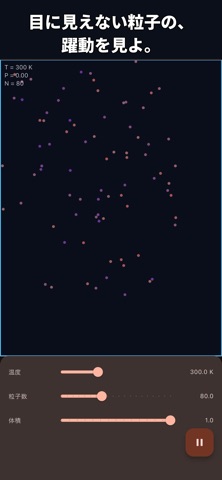

Screenshots by Fuji Bit Inc., from the the App Store listing
Description by Fuji Bit Inc. Written by the developer, not by AppBrain. Click to read.
NETURAKU is an interactive educational simulation app for experiencing thermodynamics phenomena hands-on.
The 5th app in the RAKU series following SUUGAKU (math), BUTURAKU (physics), DENRAKU (electricity), and HARAKU (waves). This time, the theme is heat. Learn and enjoy the wonders of heat and the depth of physical laws through 10 simulations.
[10 Simulations]
1. Particle Motion (Ideal Gas)
Observe particle motion in real time based on temperature. Change volume and temperature to measure pressure from wall collisions and experience the ideal gas law (PV = nRT).
2. Heat Conduction
Simulate heat diffusion using a 2D finite difference method. Adjust heat source temperatures and thermal conductivity to observe temperature distribution changes based on Fourier's law in real time.
3. Phase Transition
Matter changes state between solid, liquid, and gas as temperature varies. Intuitively experience the differences in particle behavior from lattice vibrations to free motion. Visually understand the concepts of melting and boiling points.
4. Carnot Cycle
Follow the 4 processes - isothermal expansion, adiabatic expansion, isothermal compression, and adiabatic compression - on a PV diagram. Visualize the efficiency of an ideal heat engine (eta = 1 - T_L/T_H).
5. Entropy
Simulate the mixing process of two types of gas separated by a partition. When the partition is removed, observe entropy increasing in real time on a graph.
6. Thermal Radiation (Blackbody Radiation)
Visualize the blackbody radiation spectrum (Planck distribution) in real time based on temperature. As temperature changes, the peak wavelength shifts (Wien's displacement law) and radiant energy is proportional to the fourth power of temperature (Stefan-Boltzmann law).
7. Speed Distribution (Maxwell-Boltzmann)
View the speed distribution of gas particles as a histogram alongside the theoretical curve. As temperature rises, watch the distribution broaden and its peak shift to the right. Build intuition for the most probable, mean, and root-mean-square speeds.
8. Brownian Motion
Visualize a large particle (pollen grain) undergoing irregular motion as it is buffeted by countless invisible smaller molecules. The path is drawn in real time, revealing the random-walk trajectory and how temperature and molecule count affect the motion.
9. Cooling Law (Newton's Law of Cooling)
Simulate how a hot object cools at a rate proportional to its temperature difference with the surroundings. Adjust the cooling coefficient, initial temperature, and ambient temperature to watch the exponential decay curve on the temperature-time graph approach equilibrium.
10. Diffusion (Fick's Law)
Simulate how a concentration imbalance, like a drop of ink, spreads from high to low until it becomes uniform. Tap to add ink and watch the center cross-section profile flatten (peak lowering and widening toward a uniform state).
[Features]
- Adjust parameters in real time across all simulations
- Real-time display of physics formulas and numerical values
- Dark mode / Light mode support
- Clean home screen organized by category
- Intuitive and beautiful UI
- Only a banner ad at the bottom of the home screen
- No in-app purchases or subscriptions
[Recommended For]
- Students studying thermodynamics or statistical mechanics in physics class
- Anyone who wants to intuitively understand the properties of heat
- Teachers looking for educational tools
- Everyone interested in thermodynamics and statistical physics