

Orch-OR Visualizer
Orch-OR Visualizer is made and published by Wonmo Seong. AppBrain is an independent app data site and isn't affiliated with Wonmo Seong. The app name, icon, screenshots and description belong to Wonmo Seong and are shown as published on the App Store.
AppBrain's verdict
- Last updated
- October 14, 2026
Rankings
App Store top chartsApp Store Rankings for Orch-OR Visualizer
Competitors
Similar apps and more from Wonmo SeongMore from Wonmo Seong




Releases
Updates seen on the App Store- Version
- 1.0
- Launched
- October 2026
No changelog data
User feedback
Ratings and reviews on the App StoreComments on Orch-OR Visualizer for iOS
We don't have enough comments to show example comments. Please check back later.
Technology
Found in the app by AppBrain- Price
- Free
- App size
- 2.35 MB
- Content rating
- Everyone
Technologies used by Orch-OR Visualizer
About the app and developer
About Orch-OR Visualizer
Orch-OR Visualizer is an education app developed by Wonmo Seong.
User Ratings
The app has no ratings yet.
App Information
Orch-OR Visualizer is freely available from the App Store. The app size is 2.35 MB. The latest version available is 1.0. The last update was on October 14, 2026.
Technical Requirements
The app has a content rating of Everyone. The app has been available on the App Store since October 2026.
Developer information for Wonmo Seong
Address:
Frequently asked questions about Orch-OR Visualizer
Is Orch-OR Visualizer free?
Yes. Orch-OR Visualizer is free on the App Store.
Is Orch-OR Visualizer still available?
Yes. Orch-OR Visualizer is on the App Store, and the last update we saw was on October 14, 2026.
How large is Orch-OR Visualizer?
Orch-OR Visualizer is 2.35 MB.
Is Orch-OR Visualizer suitable for children?
App Store rates the content of Orch-OR Visualizer as suitable for everyone.
Who made Orch-OR Visualizer?
Orch-OR Visualizer was developed by Wonmo Seong. It is listed in the education category on the App Store.
Store listing
By Wonmo Seong, from the App Store


Description by Wonmo Seong Written by the developer, not by AppBrain. Click to read.
• 3D microtubule — a 13-protofilament tubulin lattice you can spin and zoom. Watch superposition (violet) seed, spread by orchestration, and collapse in a flash of objective reduction.
• Live physics — gravitational self-energy E_G, the Diósi–Penrose collapse time τ = ħ/E_G, and the running ∫E_G dt → ħ that triggers each event, calibrated to Hameroff & Penrose (2014).
• Timeline — coherence over time and every collapse event, with the event rate compared to 40 Hz gamma synchrony.
• Decoherence switch — turn on environmental decoherence at Tegmark's 10⁻¹³ s or Hagan et al.'s 10⁻⁴ s and see whether coherence ever survives long enough. This is the heart of the scientific dispute.
• Calculator — how many tubulins and neurons a 25 ms conscious moment would need, with all the relevant timescales on one log axis.
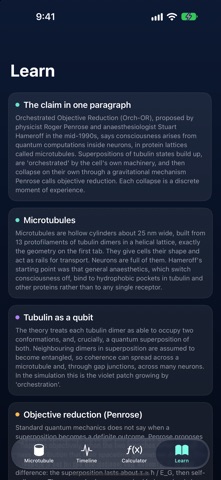
• Learn — nine short cards covering the claim, microtubules, tubulin qubits, objective reduction, orchestration, the 40 Hz argument, the decoherence objection, the evidence proponents cite (2023–2024 microtubule optics and anaesthesia studies), and where the theory stands today, with full references.
The simulation is a teaching model, not a physical one. Orch-OR is a minority view in neuroscience, and the app says so. It exists because the theory makes concrete, falsifiable numerical claims, and those are worth being able to compute.
No account, no network, no data collection.