

PhosphorDSC
PhosphorDSC is made and published by Stuart Woolley. AppBrain is an independent app data site and isn't affiliated with Stuart Woolley. The app name, icon, screenshots and description belong to Stuart Woolley and are shown as published on the App Store.
AppBrain's verdict
- Last updated
- September 29, 2026
Rankings
App Store top chartsApp Store Rankings for PhosphorDSC
Competitors
Similar apps and more from Stuart WoolleyMore from Stuart Woolley





Releases
Updates seen on the App Store- Version
- 1.0
- Launched
- September 2026
No changelog data
User feedback
Ratings and reviews on the App StoreComments on PhosphorDSC for iOS
We don't have enough comments to show example comments. Please check back later.
Technology
Found in the app by AppBrain- Price
- $0.99
- App size
- 2.25 MB
- Content rating
- Everyone
Technologies used by PhosphorDSC
About the app and developer
About PhosphorDSC
PhosphorDSC is an utilities app developed by Stuart Woolley.
User Ratings
The app has no ratings yet.
App Information
PhosphorDSC costs $0.99. The app size is 2.25 MB. The latest version available is 1.0. The last update was on September 29, 2026.
Technical Requirements
The app has a content rating of Everyone. The app has been available on the App Store since September 2026.
Developer information for Stuart Woolley
Address:
Store listing
By Stuart Woolley, from the App Store


Description by Stuart Woolley Written by the developer, not by AppBrain. Click to read.
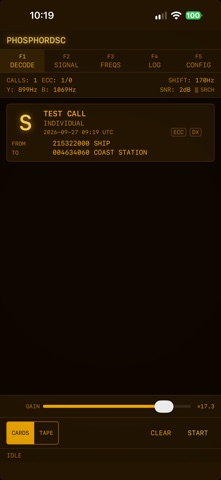
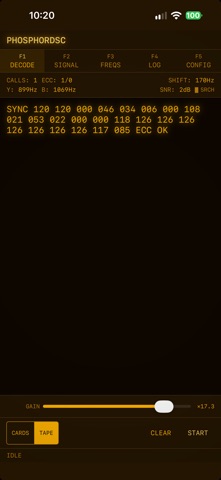
Tune a shortwave receiver to an HF or MF DSC channel, hold your iPhone near the speaker, and watch distress alerts, safety calls, urgency calls and routine ship-to-shore traffic appear on an authentic amber phosphor CRT display.
DSC is the automated calling system at the heart of the Global Maritime Distress and Safety System (GMDSS). Ships and coast stations exchange short digital bursts carrying the caller's MMSI, a priority, and for distress calls a position, a time and the nature of the emergency. PhosphorDSC decodes them all on-device. No account, no network.
SIGNAL PROCESSING
PhosphorDSC implements the ITU-R M.493 DSC protocol in Swift with purpose-written DSP.
• Ten-bit error-detecting character code, checked on every character
• Phasing-sequence lock, the way the standard intends, so character timing comes from the signal itself
• Time-diversity recovery: every character is sent twice, and a character lost in its first copy is taken from its repeat
• Error-check character verified on every call, so you know which decodes to trust
• Polarity auto-detection. Works with maritime-receiver tuning (tones near 1615 / 1785 Hz) and SDR tuning (near 1000 Hz) equally, no toggles
• Automatic frequency control with sub-bin peak interpolation and centre tracking
• Live 512-point FFT spectrum and scrolling waterfall display
DECODE VIEWS
• CARDS: each call as a colour-coded card with a priority letter (Distress, Urgency, Safety, Routine), the call type, who called whom by MMSI, coast station or ship, nature of distress, position in degrees and minutes, time and proposed working frequency. Tap a card for every field and the raw symbols
• TAPE: the raw three-digit symbol stream, for purists
WHAT IT UNDERSTANDS
• Distress alerts, distress acknowledgements, distress relays and self-cancels
• All-ships, individual, group and geographic-area calls
• Urgency, safety and routine categories
• Test calls, position requests, polling and their acknowledgements
• Working frequencies and channels, positions, UTC times and telecommands
• Repeated calls are folded into one card with a repeat count
FREQUENCY REFERENCE
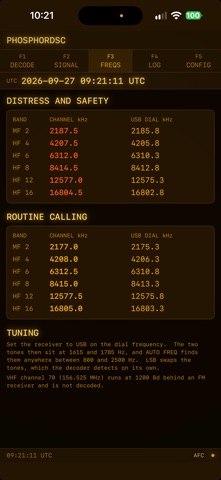
The FREQS tab lists the six HF and MF distress and safety channels (2187.5, 4207.5, 6312.0, 8414.5, 12577.0 and 16804.5 kHz) and the routine calling channels, each with the USB dial frequency to set, beside a ticking UTC clock.
CALL LOG
Every decoded call is logged locally with timestamp, decoded fields, error-check result and time-diversity statistics. Swipe to delete. Tap for the full call. Copy or share a single call, or export the whole log as plain text via the iOS share sheet.
CONFIGURATION
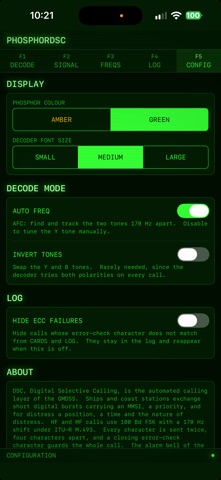
• Two phosphor themes: classic amber and green
• Three font sizes for the decoded output
• AFC on/off with manual tone override for unusual receivers
• Tone inversion for LSB-convention receivers
• Option to hide calls that fail the error check
PRIVACY
PhosphorDSC makes zero network requests. No account, no cloud, no analytics, no tracking, no third-party SDKs. Audio is processed entirely in memory. Nothing is recorded, stored or transmitted. Microphone access is used only for live signal decoding.
WHAT YOU NEED
An iPhone and a shortwave receiver in USB, tuned to an HF or MF DSC channel. 8414.5 kHz and 2187.5 kHz are the distress channels every ship's controller watches. WebSDR audio played through a speaker works too. VHF channel 70 is not decoded.
PhosphorDSC is part of the Phosphor suite of retro-CRT radio tools: PhosphorTEX (NAVTEX), PhosphorRTTY (RTTY), PhosphorCW (Morse), PhosphorPSK (PSK31), PhosphorFeld (Hellschreiber), PhosphorSSTV (slow-scan TV), and more.
Built in Swift with Apple's native frameworks only. No external dependencies. Runs entirely on-device.