

SASER is made and published by Ruslan Yusipov. AppBrain is an independent app data site and isn't affiliated with Ruslan Yusipov. The app name, icon, screenshots and description belong to Ruslan Yusipov and are shown as published on the App Store.
AppBrain's verdict
- Last updated
- September 21, 2023
Rankings
App Store top chartsApp Store Rankings for SASER
This app is not ranked
Competitors
Similar apps and more from Ruslan YusipovAlternatives to SASER




More from Ruslan Yusipov

Releases
Updates seen on the App Store- Version
- 2.0.4
- Launched
- March 2023
No changelog data
User feedback
Ratings and reviews on the App StoreComments on SASER for iOS
We don't have enough comments to show example comments. Please check back later.
Technology
Found in the app by AppBrain- Price
- $7.99
- App size
- 2.62 MB
- Content rating
- Everyone
Technologies used by SASER
About the app and developer
About SASER
SASER is an utilities app developed by Ruslan Yusipov.
What is the rating of SASER?
SASER has no ratings yet.
Is SASER free?
SASER costs $7.99. The app size is 2.62 MB. The latest version available is 2.0.4. The last update was on September 21, 2023.
What are the requirements for SASER?
The app has a content rating of Everyone. The app has been available on the App Store since March 2023.
Developer information for Ruslan Yusipov
Address:
Store listing
By Ruslan Yusipov, from the App Store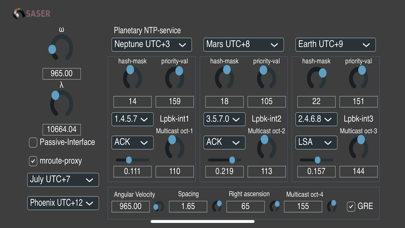
Screenshots by Ruslan Yusipov, from the the App Store listing
Description by Ruslan Yusipov Written by the developer, not by AppBrain. Click to read.
1. SASER software capable of receiving the incoming signal for VLF stations by retranslating it with internal synthesizer engine. The stronger the signal of VLF radio station, the more sound amplification it produces. The scanner of SASER software capable of switching VLF radio stations according to a set of rules for predefined monitoring.
2. Derived hyperbolic function uses up to 1536 points of distributed network service, which lowers the potential risk of DDoS by 1536 times. SASER software capable of suppressing radio stations signal with digital processors resolution of up to 192-bit. The fundamental approach of SASER software is to organize unicasting translation using digital ether from existing radio stations and if no signal is present to switch to internal digital ether generator.
3. SASER software reproduces VLF network of radio stations without physical limitations of wave propagation. The algorithm of SASER software modem works not only on a spectral level, but also on the real-time event generator level by merging three levels of operation at once.
4. You can use the signals of VLF radio stations for unicast translation. SASER software can translate incoming signals into the internal network of 1536 points.
5. You can view the system of SASER software as a solution for transport networks used in VLF radio stations.
6. The sequencer of SASER software uses approximation operations in a spherical space for playback of resulting radio signals, formed in a presence of signal constellations.