

Solar Panel Calculator Plus
Solar Panel Calculator Plus is made and published by Nitrio. AppBrain is an independent app data site and isn't affiliated with Nitrio. The app name, icon, screenshots and description belong to Nitrio and are shown as published on the App Store.
AppBrain's verdict
Established- Rating on App Store
- 3.35
- 23 ratings
- Last updated
- December 17, 2025
It doesn't have enough ratings yet to judge what users think.
Rankings
App Store top chartsApp Store Rankings for Solar Panel Calculator Plus
Competitors
Similar apps and more from NitrioAlternatives to Solar Panel Calculator Plus





More from Nitrio


Releases
Updates seen on the App Store- Version
- 1.2
- Launched
- March 2018
No changelog data
User feedback
Ratings and reviews on the App StoreComments on Solar Panel Calculator Plus for iOS
We don't have enough comments to show example comments. Please check back later.
Technology
Found in the app by AppBrain- Price
- $2.99
- App size
- 8.46 MB
- Content rating
- Everyone
Technologies used by Solar Panel Calculator Plus
About the app and developer
About Solar Panel Calculator Plus
Solar Panel Calculator Plus is a productivity app developed by Nitrio.
User Ratings
Solar Panel Calculator Plus is rated 3.35 out of 5 stars. The rating is based on 23 ratings.
App Information
Solar Panel Calculator Plus costs $2.99. The app size is 8.46 MB. The latest version available is 1.2. The last update was on December 17, 2025.
Technical Requirements
The app has a content rating of Everyone. The app has been available on the App Store since March 2018.
Developer information for Nitrio
Address:
Frequently asked questions about Solar Panel Calculator Plus
Is Solar Panel Calculator Plus free?
No. Solar Panel Calculator Plus costs $2.99 on the App Store.
Is Solar Panel Calculator Plus still available?
Yes. Solar Panel Calculator Plus is on the App Store, and the last update we saw was on December 17, 2025.
How large is Solar Panel Calculator Plus?
Solar Panel Calculator Plus is 8.46 MB.
Is Solar Panel Calculator Plus suitable for children?
App Store rates the content of Solar Panel Calculator Plus as suitable for everyone.
How do people rate Solar Panel Calculator Plus?
Solar Panel Calculator Plus scores 3.35 out of 5 stars, from 23 ratings on the App Store.
Who made Solar Panel Calculator Plus?
Solar Panel Calculator Plus was developed by Nitrio. It is listed in the productivity category on the App Store.
What are the best alternatives to Solar Panel Calculator Plus?
People looking at Solar Panel Calculator Plus also look at these productivity apps: SolarMeter sun energy planner, Solar Consult Pro, Solar Calculator OffGrid, Appliance Cost Calculator Plus, leaDCalc.
Store listing
By Nitrio, from the App Store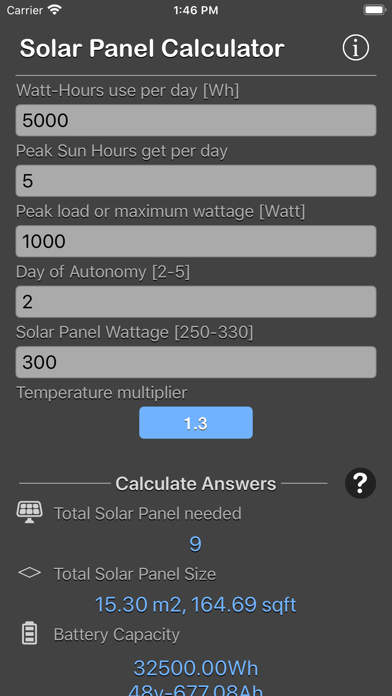




Description by Nitrio Written by the developer, not by AppBrain. Click to read.
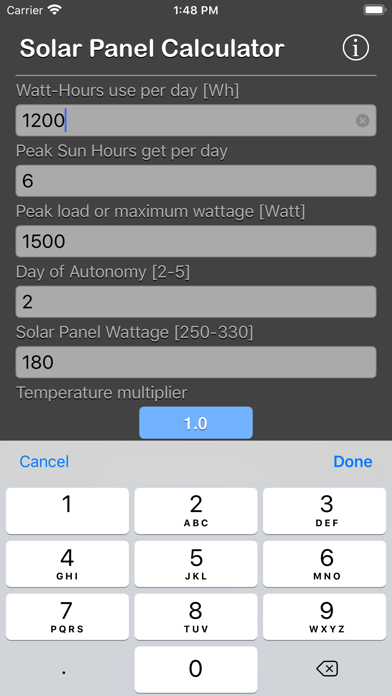
Daily energy use:
Find the energy used in a day. Figure out how long each electronic device will be run in hours during a day. Multiply the wattage of each device by its run-time to get the energy in watt-hours per day. Add up all the watt-hour values to get a total for your home.
Example: Light bulbs run for 5 hours a day. Computer runs for 2 hours a day. 100 x 5 + 300 x 2 = 1100 watt-hours.
Inverter size:
To determine the inverter size we must find the peak load or maximum wattage of your home. This is found by adding up the wattage of the appliances and devices that could be run at the same time. Include everything from microwaves and lights to computers and clocks. The sum will tell you which inverter size you need.
Example: A room has two 60 watt light bulb and a 300 watt desktop computer. The inverter size is 60 x 2 + 300 = 420 watts. Multiply with 1.2 or 1.5 into a safe area.
Days of autonomy:
Now decide how many days worth of energy you want to store in your battery bank. Generally this is anywhere from two to five.
Battery bank capacity:
Example: You want the battery bank to last three days without recharging and that you use 5.0 kwh per day.
As 5.0 x 3 x 2 = 30.0kwh, this is the energy we need from the batteries.
Converting this to AH we have to divide by the voltage of your system.
This can be 12, 24 or 48 for commercial application. If we choose to use 48V, the minimum AH capacity is then 30 000/48 = 625 AH.
Now if you divide by your battery's rating you find the number of batteries you must use.
The larger the system you have, the higher the voltage you should have. It is normal to match a 12 V battery bank to a 400 W power system. A 5 kW system would work most appropriately with a 48 V wiring system, in order to decrease current flow in the wires.
Note: All calculations assume only a 50% discharge to your batteries to optimize battery life.
Note: Colder temperatures have a negative effect on the capacity of your battery bank. If your battery bank is always indoors in a heated area then you don't have a problem. But if they're stored in an unheated area during the winter then you'll need to account for this.
Solar Panel:
The most typical solar panel size used for residential installations is 65 inches by 39 inches. And the wattage output range from 200 - 330 watts.
*Thanks for your support, stay tune for more update to come