

SOLO [Nr.19] is made and published by apeSoft. AppBrain is an independent app data site and isn't affiliated with apeSoft. The app name, icon, screenshots and description belong to apeSoft and are shown as published on the App Store.
AppBrain's verdict
Established- Rating on App Store
- 4.43
- 7 ratings
- Last updated
- September 22, 2026
It doesn't have enough ratings yet to judge what users think.
Rankings
App Store top chartsApp Store Rankings for SOLO [Nr.19]
Competitors
Similar apps and more from apeSoftAlternatives to SOLO [Nr.19]







More from apeSoft


Releases
Updates seen on the App Store- Version
- 2.2.3
- Launched
- July 2014
No changelog data
User feedback
Ratings and reviews on the App StoreComments on SOLO [Nr.19] for iOS
We don't have enough comments to show example comments. Please check back later.
Technology
Found in the app by AppBrain- Price
- Free
- App size
- 60.5 MB
- Content rating
- Everyone
Technologies used by SOLO [Nr.19]
About the app and developer
About SOLO [Nr.19]
SOLO [Nr.19] is a music app developed by apeSoft.
What is the rating of SOLO [Nr.19]?
SOLO [Nr.19] is rated 4.43 out of 5 stars, based on 7 ratings.
Is SOLO [Nr.19] free?
SOLO [Nr.19] is free. The app size is 60.46 MB. The latest version available is 2.2.3. The last update was on September 22, 2026.
What are the requirements for SOLO [Nr.19]?
The app has a content rating of Everyone. The app has been available on the App Store since July 2014.
Developer information for apeSoft
Address:
Store listing
By apeSoft, from the App Store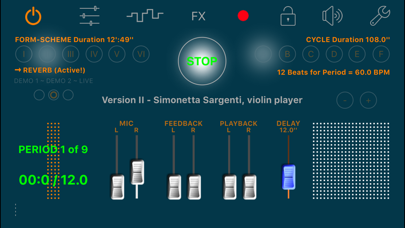
Description by apeSoft Written by the developer, not by AppBrain. Click to read.
You can hear fully the first version performed by Enrico Francioni (Contrabass) and the second version performed by Simonetta Sargenti (Violin)
***
SOLO [Nr.19] is an algorithm that aims to implement digitally the original analog set-up for the performance of six versions of Solo für melodieninstrument mit rückkopplung by Karlheinz Stockhausen.
The original composition was conceived for five persons. Four technicians plus the main instrument performer. SOLO [Nr.19], performs the work of four technicians for each of the six Stockhausen's versions.
"Solo" (für Melodieninstrument mit Rückkopplung) by Karlheinz Stockhausen is a piece written for any solo melodic instrument and employs a feedback system to allow the soloist to create polyphonic music. Written in 1966 with its world premiere in Tokyo in the same year, its origin dates back to the same period as the composer's work "Kontakte". "Solo" uses the technique of recording onto tape with a single head together with a moveable arrangment of playback heads, allowing for the creation of complex sounds through accumulation.
The original version (with an analog technical set-up) requires a solo instrumentalist as 4 assistants (technicians): three assistants operating the opening and closing of sliders (L/R channels)–respectively the microphone, delay-line and output–and an assistant for the change of time values of the taps in the delay-line. During a performance a part of what the instrumentalist plays is captured by a two-channel recorder. Through a feedback circuit, the sections are recorded more or less densely stacked and processed with a variable delay time; the result is then played by two sets of speakers and mixed with the direct sound of the soloist.
The score (Universal Edition-Wien, 1969) consists of six pages of music and six pages of Form- Schema (the number six can be considered a key element), in addition to explanatory notes (very detailed) for the performance the composition. "Solo" is one of those compositions by the author employing "controlled alea" as a compositional language. Indeed many choices are left to the soloist and cover almost all the events: from the selection of a version, the positioning of the material, the types of tonal variation requests, the order of pages and more. In reality these faculty are provided as input by the composer through the management of macroscopic or microscopic order parameters, restricting the possible versions (virtually infinite) at a predefined or definable set of possibilities. In this piece, the role of the interpreter is very important in the creation of a performance that is always unique and unrepeatable every time.