

TerrHum is made and published by Augusto Zanella. AppBrain is an independent app data site and isn't affiliated with Augusto Zanella. The app name, icon, screenshots and description belong to Augusto Zanella and are shown as published on the App Store.
AppBrain's verdict
Established- Rating on App Store
- 4.00
- 1 ratings
- Last updated
- January 22, 2022
It doesn't have enough ratings yet to judge what users think.
Rankings
App Store top chartsApp Store Rankings for TerrHum
Competitors
Similar apps and more from Augusto ZanellaAlternatives to TerrHum








Releases
Updates seen on the App Store- Version
- 2.0
- Launched
- June 2018
No changelog data
User feedback
Ratings and reviews on the App StoreComments on TerrHum for iOS
We don't have enough comments to show example comments. Please check back later.
Technology
Found in the app by AppBrain- Price
- Free
- App size
- 17.6 MB
- Content rating
- Everyone
Technologies used by TerrHum
About the app and developer
About TerrHum
TerrHum is an education app developed by Augusto Zanella.
What is the rating of TerrHum?
TerrHum is rated 4.00 out of 5 stars, based on one rating ratings.
Is TerrHum free?
TerrHum is free. The app size is 17.59 MB. The latest version available is 2.0. The last update was on January 22, 2022.
What are the requirements for TerrHum?
The app has a content rating of Everyone. The app has been available on the App Store since June 2018.
Developer information for Augusto Zanella
Address:
Store listing
By Augusto Zanella, from the App Store


Description by Augusto Zanella Written by the developer, not by AppBrain. Click to read.
With this application, it is possible to classify all non-submerged forest topsoils of our planet. The app is built on the indications about humus forms and systems reported in eight scientific articles collected in an Applied Soil Ecology special issue entitled Humusica 1 (Zanella, A., Ascher-Jenull, J., 2018. Editorial. Appl. Soil Ecol. 122, 1–9. doi:https://doi.org/10.1016/j.apsoil.2017.11.029).
The articles are the fruit of many years of researches and meetings of a Humus Group gathering more than 50 soil ecologists, biologists, and naturalists.
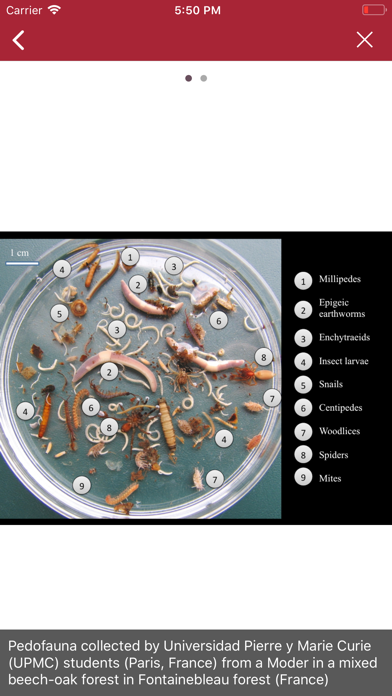
Once all figures (about 150) have been opened a first time (with a fiber connection, the download of all the figures takes few minutes), the iOS device on which the application has been downloaded does not need to be connected to the Internet to run the application. The recall through touch-buttons of photographs allows a classification of the humus forms and the main groups of animals that live there even for beginners.
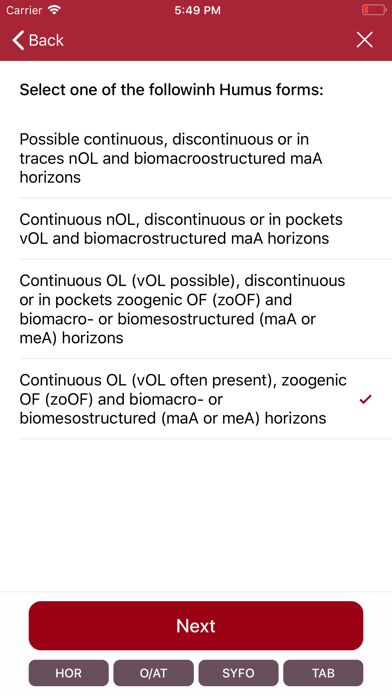
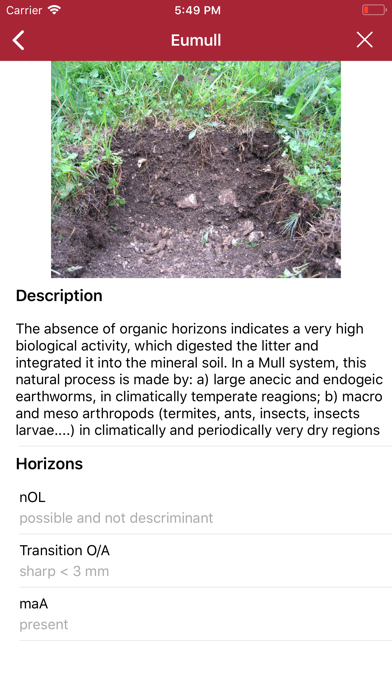
Let us consider a user faced with a soil profile to be classified. A cubic volume of 50×50×50 cm is generally sufficient for studying humus systems and forms in a forest environment, while a larger hole or many well-distributed small holes are necessary for surveying a heterogeneous area. As a humus form is made of superposed humus horizons, the app asks the user to indicate one-by-one which types of humus horizons are present in the observed profile. The user is asked to answer a series of YES/NO questions. He can use the touch-buttons for help and display examples of horizons, types of transition or humus systems, as well as forms and tables of composition/classification of humus horizons, or groups of animals and droppings. At the end of the survey, a photograph of the target humus form appears, along with a list of the chosen horizons.
By clicking/touching on the screen, each photograph may be magnified. A caption that appears at the bottom of the picture provides access to the morpho-functional features of the soil profile that lead to the result: the final classification of the humus system. The app is freely downloadable and in continuous evolution (automatic update). To contribute to its improvement, simply send your suggestions, photographs, schemes, etc. to: augusto.zanella@unipd.it. Your name will be reported alongside a photograph or a relevant improvement, as in an open source app.
Information about the topsoil classification and indications about the topsoil functioning are given in Humusica 1, articles 1, 2 and 3. Supplemental specific information about diagnostic horizons and humus forms may be found in Humusica 1, articles 4, 5 and 6. Sampling panel and pedofauna are illustrated in Humusica 1, articles 7 and 8.
Humusica 1 articles here: https://www.sciencedirect.com/journal/applied-soil-ecology/vol/122/part/P1.
Corresponding author: augusto.zanella@unipd.it