

Vascular - Tactile Synth
Vascular - Tactile Synth is made and published by Absolute Management SIA. AppBrain is an independent app data site and isn't affiliated with Absolute Management SIA. The app name, icon, screenshots and description belong to Absolute Management SIA and are shown as published on the App Store.
AppBrain's verdict
New- Rating on App Store
- 4.83
- 6 ratings
- Last updated
- October 12, 2026
- Size
- 101.1 MB
Vascular - Tactile Synth came out 32 days ago. It doesn't have enough ratings yet to judge what users think.
User feedback
Ratings and reviews on the App StoreComments on Vascular - Tactile Synth for iOS
We don't have enough comments to show example comments. Please check back later.
Store listing
By Absolute Management SIA, from the App Store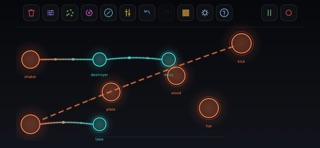


Description by Absolute Management SIA Written by the developer, not by AppBrain. Click to read.
FEATURES
- 55 synthesis families, including subtractive, FM, additive, granular, spectral, physical modelling, wavetable, wave-terrain, pulsar and stochastic synthesis.
- 3 macrosynths, complete synthesizers in a single node: resurgent (2 scenes, 3 oscillators, 2 filters, effects), bayarea, a West Coast voice, and poundhard, an FM drum voice from kicks to industrial percussion.
- A complete DX7 implementation.
- Holos, a special node that combines elements and parameters from other nodes to create a new semi-modular synthesizer instantly.
- A sample player for loading your own loops, with time-stretching, forward and reverse playback, stuttering, splicing and tape-style manipulation derived from classic electroacoustic techniques.
- Sampled acoustic instruments that generate melodic loops in the session's tonal key.
- Drum synthesis, a 303, a 16-oscillator supersaw and live granular processing.
- Microphone input for processing external sound.
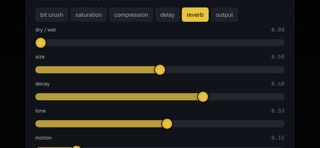
- 71 processors, including filters, distortion, delays, combs, phasing, diffusion, reverb, spectral freezing, convolution, pitch tracking, harmony, vocoding, spectral delays, tape loops and broken-media effects.
- Host your own AUv3 instruments, effects and MIDI plugins as nodes on the canvas, their settings kept with your sessions (in-app purchase).
- 7 controllers that play or move other nodes: a melodic sequencer with a piano-roll editor; an arpeggiator that turns a single arpeggio into a fugue across up to 6 voices; a drum machine with fills and breaks; a shift register; bouncing cars whose collisions are notes; a Game of Life swept by a playhead; and an LFO controller with 3 LFOs on each of up to 6 nodes.
- Kick side chains with adjustable depth, and a master bus compressor.
- An effects sequencer with 4 lanes of any processor, each with its own length.
- A randomizer that creates whole patches, transforms what is on the canvas, expands it or dismantles it, and deals or removes LFOs, gates and motifs.
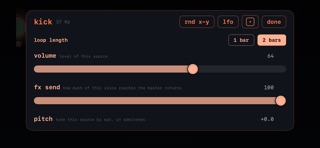
- A padlock on every parameter, keeping it out of reach of the randomizer and every LFO.
- Mute and solo: tap a node to mute it, hold it to hear it alone with its chain.
- Angiogenesis, which moves nodes, rewires connections, adds processors and changes their parameters automatically. It never removes your voices, cuts a controller's connections or modifies microphone nodes.
- Adjustable mutation rate and automatic adaptation to the processing capacity of the device.
- A shared session clock with tap tempo and an independent clock division for each rhythmic source.
- 27 scales from 4 musical traditions, plus microtonal tunings imported from Scala files.
- Guided paths for restricting generators and processors to a selected musical territory.
- A searchable palette, in alphabetical order, with favourites.
- Rebalance, which spreads the outputs evenly across the whole stereo field.
- A multilayer gesture looper.
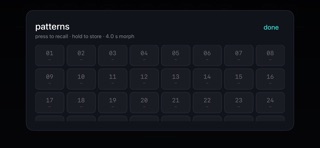
- 32 pattern slots with adjustable morphing between complete instrument states.
- Sessions that store the network, settings and tonal key together.
- 48 levels of undo and redo.
- Recording, playback, renaming and sharing of takes.
- A transport that stops active sound sources while allowing effect tails to decay naturally.
AUV3
Vascular also runs as an AUv3 instrument in AUM, Loopy Pro, Logic and other compatible hosts, and follows the host's tempo and transport.
The interface runs full-screen in landscape orientation and is operated directly with your fingers. The main buttons remain along the top of the display, away from the hand interacting with the canvas.
Safety and technology
Found in the app by AppBrain- Price
- $3.99
- App size
- 101.1 MB
- Content rating
- Everyone
Technologies used by Vascular - Tactile Synth
Releases
Updates seen on the App Store- Version
- 2.3
- Launched
- September 2026
No changelog data
Rankings
App Store top chartsApp Store Rankings for Vascular - Tactile Synth
About the app and developer
About Vascular - Tactile Synth
Vascular - Tactile Synth is a music app developed by Absolute Management SIA.
User Ratings
Vascular - Tactile Synth is rated 4.83 out of 5 stars. The rating is based on 6 ratings.
App Information
Vascular - Tactile Synth costs $3.99. The app size is 101.14 MB. The latest version available is 2.3. The last update was on October 12, 2026.
Technical Requirements
The app has a content rating of Everyone. The app has been available on the App Store since September 2026.
Developer information for Absolute Management SIA
Address:
Frequently asked questions about Vascular - Tactile Synth
Is Vascular - Tactile Synth free?
No. Vascular - Tactile Synth costs $3.99 on the App Store.
Is Vascular - Tactile Synth still available?
Yes. Vascular - Tactile Synth is on the App Store, and the last update we saw was on October 12, 2026.
How large is Vascular - Tactile Synth?
Vascular - Tactile Synth is 101.14 MB.
Is Vascular - Tactile Synth suitable for children?
App Store rates the content of Vascular - Tactile Synth as suitable for everyone.
How do people rate Vascular - Tactile Synth?
Vascular - Tactile Synth scores 4.83 out of 5 stars, from 6 ratings on the App Store.
Who made Vascular - Tactile Synth?
Vascular - Tactile Synth was developed by Absolute Management SIA. It is listed in the music category on the App Store.