Ancient Light transforms your iPhone into a camera of the nineteenth century.
Twelve authentic historic photographic processes - each faithfully simulated through the physics of tone, silver chemistry, grain, paper, and light. Not filters. Processes.
-- THE TWELVE PROCESSES --
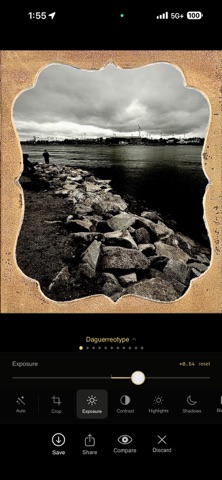
Daguerreotype (1839) - The first successful photograph. A mirror-like silver surface with luminous shadow detail and a quality that painters of the era envied.
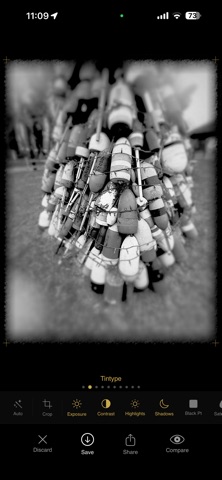
Tintype (1853) - The photograph of the working class. Robust, immediate, metallic, with regular or square format options and optional worn plate borders.
Albumen (1850s) - Warm egg-white paper prints mounted as cabinet cards, with soft sepia-brown toning, aged cream stock, rounded corners, and a ruled inner border.
Sepia - The warm brown tone of silver sulphide that preserved Victorian portraits through a century and a half.
Cyanotype (1842) - Sir John Herschel's iron-based process. Deep Prussian blue. The print that gave photography the word "blueprint."
Anthotype (1839) - Made from crushed plant pigments. Delicate, fugitive, botanical. The most poetic photographic process ever devised.
Platinum (1873) - The process of fine art portraiture. Cool, shadow-rich, with a tonal range silver could never match.
Autochrome (1907) - The Lumiere brothers' starch-grain colour process. Dreamy, pointillist, the first practical colour photography.
Wet Plate (1851) - The dominant process of the mid-19th century. Cracked emulsion, silver bubbles, edge melt, amber-olive toning.
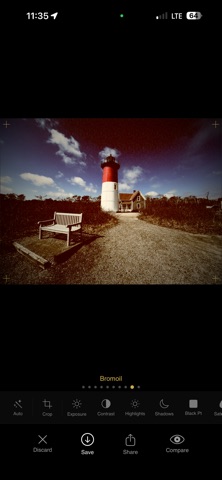
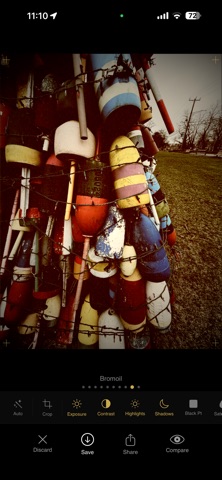
Bromoil (1907) - Oil-based ink on bleached gelatin. Painterly and stippled, with inky shadows and pale milky highlights.
Lippmann (1891) - Gabriel Lippmann's Nobel Prize-winning interferential process. Warm amber ageing, long-exposure softness, and glass plate scratches from a century of handling.
Infrared (1930s) - Light beyond the visible spectrum. Luminous white foliage, darkened skies, ethereal skin tones. The spectral world captured on heat-sensitive emulsion.
-- WHAT ANCIENT LIGHT CAN DO --
* All four optical lenses - ultrawide (0.5x), wide (1x), 2x, and telephoto (5x) - selectable from the viewfinder
* Shoot once, save many - save multiple historic versions from a single capture
* On iPhone Pro: saves both a filtered JPEG and the original 48MP ProRAW DNG as a paired asset
* Albumen cabinet-card output with warm paper tone, soft print contrast, aged stock texture, rounded card corners, and ruled border
* Infrared process with glowing foliage, dark skies, and spectral black-and-white tonality
* Tintype options - choose regular or square format, with period borders or no borders
* Seven Daguerreotype frame styles plus No Frame, selectable directly from the viewfinder
* Higher-resolution Daguerreotype frame output, scaled to the photo instead of the source frame artwork
* Adjustments apply to the photograph while preserving Daguerreotype frame artwork
* Full adjustment suite - exposure, contrast, highlights, shadows, black point, saturation, vibrance, warmth, sharpness, and vignette
* Auto enhancement with one tap
* Precision crop tool with inset handles and rule-of-thirds grid
* Landscape side-panel layout keeps the image large while all controls stay accessible
* Photographer credit field - your name travels with every saved file in the IPTC metadata
* Process, frame, and Tintype options stored between sessions
* iPhone and iPad, all orientations
* No subscription. No ads. No account required.
Ancient Light is a single purchase. Everything in it is yours.
Show more
Show less