

ChordLab is made and published by RoGame Software. AppBrain is an independent app data site and isn't affiliated with RoGame Software. The app name, icon, screenshots and description belong to RoGame Software and are shown as published on the App Store.
AppBrain's verdict
- Last updated
- October 24, 2021
Rankings
App Store top chartsApp Store Rankings for ChordLab
Competitors
Similar apps and more from RoGame SoftwareMore from RoGame Software






Releases
Updates seen on the App Store- Version
- 3.6.9
- Launched
- February 2013
No changelog data
User feedback
Ratings and reviews on the App StoreComments on ChordLab for iOS
We don't have enough comments to show example comments. Please check back later.
Technology
Found in the app by AppBrain- Price
- $9.99
- App size
- 8.79 MB
- Content rating
- Everyone
Technologies used by ChordLab
About the app and developer
About ChordLab
ChordLab is a music app developed by RoGame Software.
What is the rating of ChordLab?
ChordLab has no ratings yet.
Is ChordLab free?
ChordLab costs $9.99. The app size is 8.79 MB. The latest version available is 3.6.9. The last update was on October 24, 2021.
What are the requirements for ChordLab?
The app has a content rating of Everyone. The app has been available on the App Store since February 2013.
Developer information for RoGame Software
Address:
Frequently asked questions about ChordLab
Is ChordLab free?
No. ChordLab costs $9.99 on the App Store.
Is ChordLab still available?
Yes. ChordLab is on the App Store, and the last update we saw was on October 24, 2021.
How large is ChordLab?
ChordLab is 8.79 MB.
Is ChordLab suitable for children?
App Store rates the content of ChordLab as suitable for everyone.
Who made ChordLab?
ChordLab was developed by RoGame Software. It is listed in the music category on the App Store.
Store listing
By RoGame Software, from the App Store


Description by RoGame Software Written by the developer, not by AppBrain. Click to read.
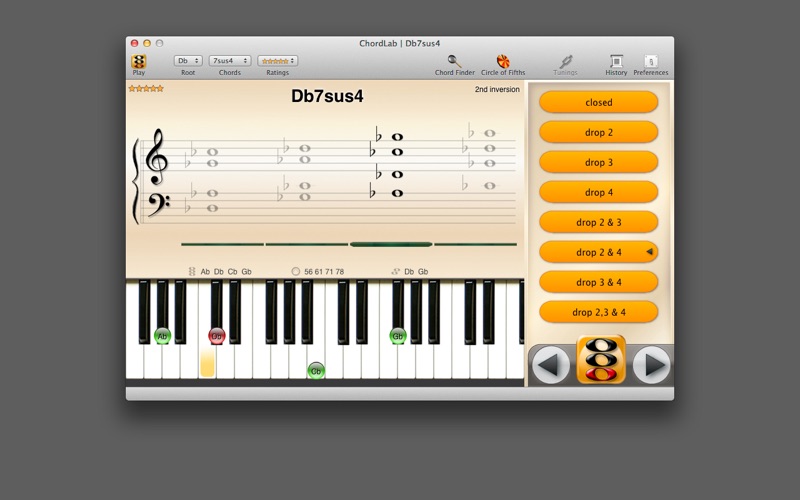
Four-part harmony may feel restrictive on instruments capable of more than 4 voices, but for a small choir for example it is a basic fact of life. It has become a staple in modern music as well as it allows the accompanist to declutter the spectrum in a sense by playing fewer notes. Root and fifth substitutions are applied automatically when dialing up a chord in ChordLab. Simply like that. Once the quality of a chord has been set it can then be viewed and listened to in all standard and not so standard drop voicings and moved through its inversions. This is of particular importance to guitar players as quite a few voicings are impossible to play and one may be left with rather few options. Chord spelling is also the main feature of ChordLab's Apple Watch app.
ChordLab has an interactive Circle of Fifths. With it we can look up key signatures for major and minor scales as well as all other modes derived of the major scale. So it is possible for example to display key signatures for all mixolydian scales and simultaneously highlight the other degrees for that mode. Additionally ChordLab displays degree structures for a key in standard Roman numerals. This is extremely useful when putting together chord progressions. Roots of the current harmonic domain are highlighted in white and can be tapped to audit the associated chords.
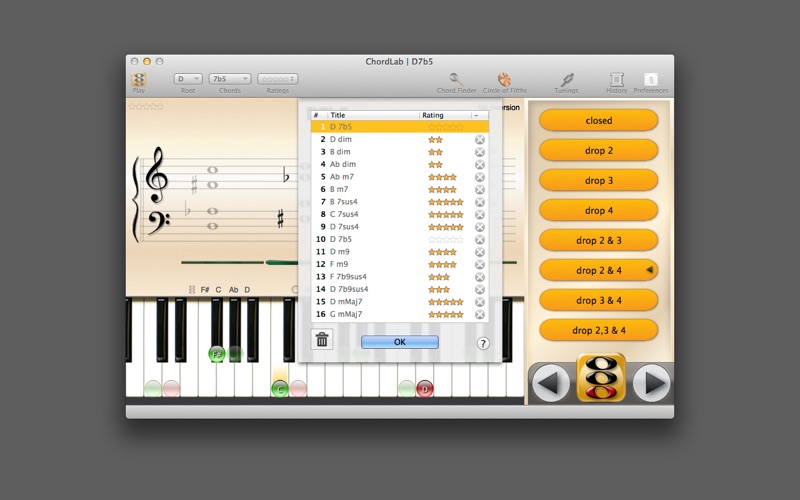
The chord finder feature in ChordLab allows you to search its database for 3 or 4 note structures to determine their harmonic quality. To find a chord in its database ChordLab uses the enharmonically simplest solution and does not require you do know whether a note is called G# or an Ab. This is especially useful for guitarists that seldomly encounter chords in root position due to the tuning of the instrument.
Features include:
• Chord spelling for all common chords
• Notation and textual representation of chord tones
• Chord finder for triads and seventh chords
• Alto, bass, tenor, treble clefs, TAB and grand staff
• All inversions and standard voicings
• Virtual piano and guitar instruments
• Chord tone labeling in instrument views
• All common open and alternate tunings presets (guitar)
• Automatic root and fifth substitution
There is a lot of functionality built into ChordLab, but as with any tool it is what we make of it. If chord spelling is a term in your vocabulary ChordLab should be of interest. Or maybe you want to grow your chord reportoire. Putting music theory into words often makes it sound overly complex yet nobody would say that orange or purple are complicated. ChordLab lets you play and work with colors in a sense and shows you how to play them on your instrument. It is very a unique tool for musicians, song-writers, professionals and music students and one that you will find yourself coming back to again and again.