

EcoJar: Fish Tank Simulator
EcoJar: Fish Tank Simulator is made and published by Kunliang Wu. AppBrain is an independent app data site and isn't affiliated with Kunliang Wu. The app name, icon, screenshots and description belong to Kunliang Wu and are shown as published on the App Store.
AppBrain's verdict
- Last updated
- October 14, 2026
Rankings
App Store top chartsApp Store Rankings for EcoJar: Fish Tank Simulator
Competitors
Similar apps and more from Kunliang WuMore from Kunliang Wu




Also available on Google Play

Releases
Updates seen on the App Store- Version
- 2026.10.1
- Launched
- September 2026
No changelog data
User feedback
Ratings and reviews on the App StoreComments on EcoJar: Fish Tank Simulator for iOS
We don't have enough comments to show example comments. Please check back later.
Technology
Found in the app by AppBrain- Price
- Free
- App size
- 36.9 MB
- Content rating
- Everyone
Technologies used by EcoJar: Fish Tank Simulator
About the app and developer
About EcoJar: Fish Tank Simulator
EcoJar: Fish Tank Simulator is an entertainment app developed by Kunliang Wu.
User Ratings
The app has no ratings yet.
App Information
EcoJar: Fish Tank Simulator is freely available from the App Store. The app size is 36.92 MB. The latest version available is 2026.10.1. The last update was on October 14, 2026.
Technical Requirements
The app has a content rating of Everyone. The app has been available on the App Store since September 2026.
Developer information for Kunliang Wu
Address:
Store listing
By Kunliang Wu, from the App Store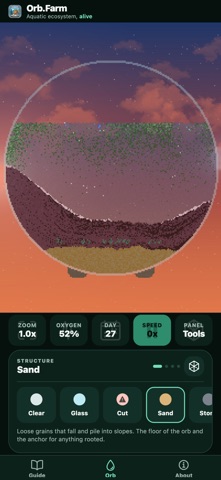




Description by Kunliang Wu Written by the developer, not by AppBrain. Click to read.
EcoJar is an aquarium made of cellular automata. Every grain of sand falls, every bubble rises, every alga photosynthesizes, one cell at a time, across forty thousand cells. Nothing is decoration and nothing runs on a timer: if the oxygen falls, it fell because something in your jar breathed it.
BUILT ON ORB.FARM
EcoJar is a fork of orb.farm, Max Bittker's open-source sandbox. We kept the engine and the feel: the cells, the light, the day and the night. We rebuilt what happens inside: how fish live and die, how oxygen swings through the night, how a jar starts, and which species can live here. Every change is measured against the original in a headless simulator before it ships. Play the original at orb.farm; its source is at github.com/MaxBittker/orb.farm.
THE OXYGEN BUDGET IS THE WHOLE THING
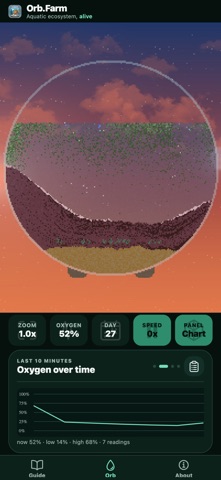
Oxygen and carbon dioxide are tracked as real quantities, produced and consumed cell by cell. Aquatic plants and algae only make oxygen where light reaches them, so the curve climbs through the day and turns over at dusk. Every animal spends it all night, whether you watch or not. A jar with too many fish and too little light does not fail dramatically. It fails quietly at four in the morning, and you find out from the chart.
THE LOOP THAT KEEPS A SEALED JAR ALIVE
Waste sinks. Bacteria break it down, and what they leave behind is nitrogen. Nitrogen drifts down until it reaches sand or a plant, feeds it, and releases a bubble on the way. Nitrogen that finds nothing returns to plain water. That is the loop a real closed ecosystem runs on, and it decides whether you get a planted tank that feeds itself or cloudy water.
WHAT YOU CAN DRAW WITH
Twelve materials, each with its own behaviour, plus Clear and Cut.
- Sand, stone, wood and glass build the jar. Sand piles into slopes and anchors anything rooted.
- Water finds its level and carries what is dissolved in it.
- Algae is the engine room: it photosynthesizes, spreads, and blooms first when there is more light and nitrogen than anything can use.
- Grass and plants are the slower producers, and what nitrogen feeds directly.
- Bacteria are the recyclers. Without them, waste accumulates.
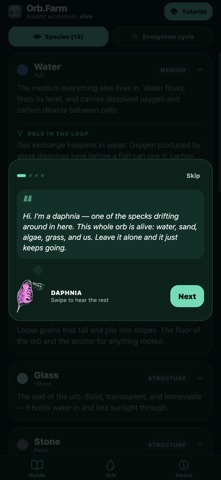
- Daphnia and zooplankton are the food web's middle, and the difference between a clean jar and a green one.
- Fish and goldfish sit on top, and go first when the water cannot keep up.
HOW TO BUILD A JAR THAT SURVIVES
Start smaller than you want to. A nano aquarium of sand, water and algae runs a long time alone. Add one daphnia population and watch a single grazer flatten an algae bloom. Only then add a fish. Most people add the fish first, and lose that jar. A nano aquarium of sand and algae, a closed terrarium of grass and bacteria, an aquascape of plants and stone: all legitimate, all failing differently.
WHY MOST FIRST ATTEMPTS DIE
Three reasons, in order: too many animals for the algae; algae with too little light; a jar packed so tightly the gases have nowhere to buffer. None of it is scripted. The chart tells you well before the fish do.
WHAT IS NOT SIMULATED
No water temperature, because this simulation does not model it. No pH, no hardness, no ammonia number. We would rather say so than print a number that means nothing.
WHAT IT ASKS OF YOU
Nothing. No score, no level, no daily reward, no timer, nothing to buy. It is a cozy aquarium you can put down for a week. Build a jar, watch the oxygen curve, and decide for yourself whether it is a good one.
PRIVACY
No account. No analytics. No advertising identifier. Everything runs on your device, and your jar lives in this app's own storage. Uninstalling deletes it.
EcoJar uses the orb.farm engine under the MIT License and is not affiliated with or endorsed by its author. The full license text is in the app under About.