It doesn't have enough ratings yet to judge what users think.
Landscape Alternatives is made and published by
Charles T. Bargeron.
AppBrain is an independent app data site and isn't affiliated with Charles T. Bargeron.
The app name, icon, screenshots and description belong to Charles T. Bargeron and are shown as
published on the App Store.
About Landscape Alternatives
Landscape Alternatives is an education app developed by Charles T. Bargeron.
What is the rating of Landscape Alternatives?
Landscape Alternatives is rated 4.80 out of 5 stars, based on 5 ratings.
Is Landscape Alternatives free?
Landscape Alternatives is free. The app size is 350.77 MB. The latest version available is 2.4.5. The last update was on September 20, 2021.
What are the requirements for Landscape Alternatives?
The app has a content rating of Everyone. The app has been available on the App Store since September 2012.
Description by Charles T. Bargeron(from the App Store)
Everybody loves a beautiful garden. Gardeners love plants that are adaptable, tough, and fast-growing. It’s even better if that plant produces showy fruits that attract birds or is an annual that self seeds, so it doesn’t need to be replanted every year. Unfortunately, many of these plant traits desirable to gardeners can also increase the likelihood that a plant jumps the garden fence and invades natural areas.
Invasive plants threaten our environment and economy. They pose an enormous threat to our native plants, animals, and ecosystems, and they cost the United States approximately $35 billion per year (www.invasivespecies.gov).
Although invasive plants are almost always not native to a region, it is important to note that most non-native species are not invasive. We use the following definitions.
Native (indigenous): A species that was present in North American prior to European settlement or has arrived since through natural means of dispersal.
Non-native (exotic, alien, introduced): A species that was brought to North America by humans, either deliberately or accidentally.
Invasive: A non-native whose introduction does or is likely to cause economic or environmental harm or harm to human health (from Federal Executive Order 13112).
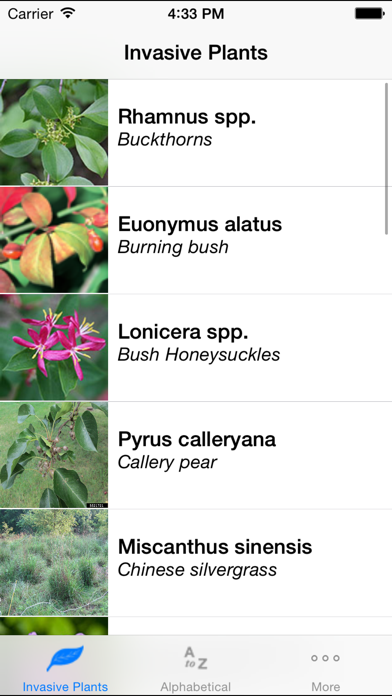
People have introduced invasive species both accidentally and deliberately. This app focuses on plant species that are used ornamentally and have become invasive in at least part of the Midwest. Cultivars or hybrids produced from these species may or may not be invasive. In the few published cultivar evaluation studies, some cultivars prove to be more invasive than the parent species, others less or not invasive. We lack research about cultivar invasiveness for many of these species. When we have good evidence about a problematic or relatively benign cultivar, we list those specifically.
Suggested alternatives include both native species and non-native species that currently show no signs of becoming invasive.
Each subscription will automatically renew 3 days before the expiration date for
the same time period. Subscriptions can be cancelled at any time before the renewal.