Nobody remembers the score at 4-5 in the third. Luasc does. One swipe per point on your Apple Watch, or a turn of the crown, keeps games, sets, deuce, tiebreaks and change of ends straight, so you can keep your head in the match.
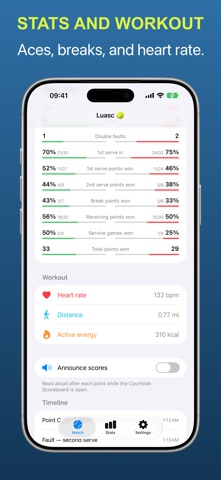
Best with an Apple Watch. The whole session — warm-up included — is recorded as a real tennis workout, so heart rate, distance and active energy land in Health and Fitness alongside everything else. Scoring and logging the workout are one act: start the warm-up, play, and it's all there afterwards. The watch app runs on its own, so the phone can stay in the bag. Haptics confirm every point, and a proper undo stack forgives the ones you didn't mean.
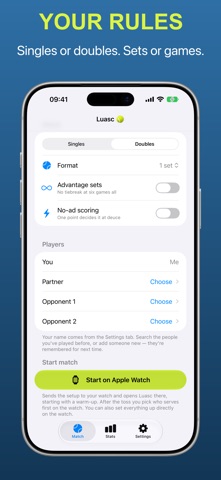
No watch, or playing on an iPad? Score the whole match on the phone instead. Go point by point with ace, double fault and let, or — if you're honestly not walking back between points — tap once per game and leave it at the net post. Phone scoring doesn't record a workout; that part needs the watch.
When the watch is keeping score, your iPhone mirrors it live. Either phone or iPad can go full-screen as a courtside scoreboard, built to sit at the net post, with tap-to-score when it's the device doing the scoring. Your iPhone will call the score out loud too, if you want it to — it's a toggle.
The formats, done properly:
- Singles and doubles, with correct serve rotation inside a doubles team
- One set, best of three, or best of five
- A ten-point match tiebreak in place of the deciding set, when your club plays the third as a breaker
- Or the deciding set played out in full, with its tiebreak at 6-6 run to ten points, the way all four Slams have played it since 2022
- Advantage sets, if your club doesn't play a tiebreak at six games all: the set runs on until someone leads by two, so it can finish 8-6 or 12-10
- A fixed number of games, played out in full: most games wins, level is a draw
- TieBreak Tens
- Advantage deuce, or no-ad scoring, where one point decides it at deuce
- Seven-point tiebreak at 6-6 in an ordinary set, with the serve rotation and change-of-ends prompts right
Afterwards, on your iPhone:
- Every match you've played, kept in full — free shows the 20 most recent
- A momentum chart for each match, built from every point of it
- A player directory, so regulars are a tap, not a typing exercise. Starting on the watch is deliberately one tap with no name entry, so those matches begin under placeholders and you put names to them later
- A share card for any finished match, drawn on the phone: the scoreboard plus your choice of the momentum line, your stats against theirs, the match in a sentence, your own numbers or the result alone, in a post shape or a story shape
Free is the whole game, for good: every format, the workout, per-match stats, the courtside scoreboard, the momentum chart, the share cards, and iCloud backup of the lot. Luasc Pro is the long view: your history past the 20 most recent matches, win-loss-draw records with and against every player you've met, your results month by month, and your serve and return over time. It can remember where you played too — one location fix as the match starts, turned into a venue name. Never a route, never continuous tracking, and off until you switch it on.
Luasc Pro is a monthly or yearly subscription, both starting with 7 days free, or one payment if you'd rather own it outright. Prices for your country are on this page, under In-App Purchases. Matches past your most recent 20 are hidden, never deleted: they stay on your iPhone, and in your iCloud backup if you use one. Go Pro and they're all back.
No account. No sign-up, no password, nothing of yours on a server of ours — because there isn't one. Your history, players, presets and settings sync between your own devices through your private iCloud and stay there. No ads either.
Luasc is Irish for "swing". It's pronounced LOO-sk.
Terms of Service can be found here: https://www.apple.com/legal/internet-services/itunes/dev/stdeula/
Show more
Show less