

SEIRAKU is made and published by Fuji Bit Inc. AppBrain is an independent app data site and isn't affiliated with Fuji Bit Inc. The app name, icon, screenshots and description belong to Fuji Bit Inc. and are shown as published on the App Store.
AppBrain's verdict
- Last updated
- June 4, 2026
- Size
- 24.4 MB
User feedback
Ratings and reviews on the App StoreComments on SEIRAKU for iOS
We don't have enough comments to show example comments. Please check back later.
Store listing
By Fuji Bit Inc., from the App Store

Description by Fuji Bit Inc. Written by the developer, not by AppBrain. Click to read.
Part of the popular science learning series including SUUGAKU (math), BUTURAKU (physics), DENRAKU (electricity), HARAKU (waves), and NETURAKU (thermodynamics). This installment focuses on celestial mechanics — ten simulations that let you experience the elegant laws governing our universe.
【10 Simulations】
▶ Orbital Motion
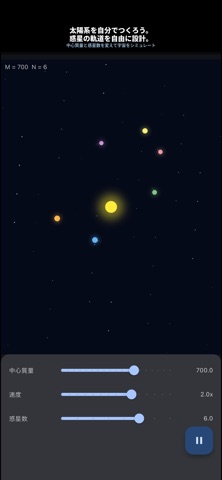
Simulate planets orbiting a central body under gravity. Freely adjust mass, speed, and the number of planets. Stable Verlet (leapfrog) integration produces beautiful orbital trails in real time.
▶ Universal Gravitation
Visualize the gravitational field of multiple massive bodies using vector arrows. Tap anywhere to add test particles and watch how they move through the field. Experience Newton's law of gravitation.
▶ Three-Body Problem
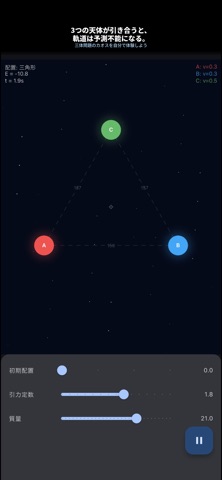
When three stars pull on one another, the motion turns wildly complex — most starting conditions diverge completely, while a few special ones trace beautiful periodic orbits. Choose between Stable Triangle, Figure-8 Orbit, Collinear, and Unstable presets to feel how gravity and velocity intertwine.
▶ Tidal Force
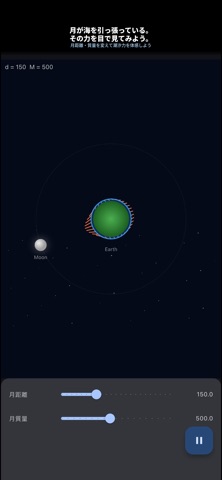
Visualize the tidal deformation that the Moon's gravity exerts on Earth. Observe how tidal force vectors and ocean bulges (3cos²θ − 1) change in real time as the Moon orbits. Adjust distance and mass to explore the concept of the Roche limit.
▶ Kepler's Laws
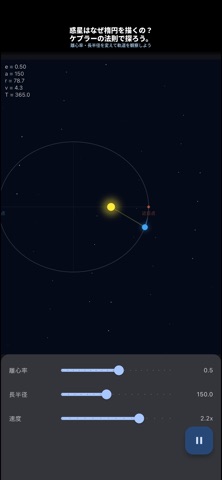
Experience Johannes Kepler's three laws of planetary motion in a single screen. Adjust eccentricity and semi-major axis freely, and see the equal-area law (2nd law) visualized through swept sectors. Compare the speed difference between perihelion and aphelion.
▶ Gravity Slingshot
A spacecraft uses a planet's gravity to change speed and direction — the technique used by Voyager and Hayabusa. Adjust planet mass, launch speed, and approach offset to see how the trajectory, speed gain, and deflection angle change.
▶ Hohmann Transfer
Visualize the classical minimum-fuel two-burn transfer between two circular orbits. The first burn (Δv₁) places the craft on a half-elliptical transfer; the second (Δv₂) circularizes onto the outer orbit. Watch Δv, the transfer half-period, and eccentricity update live — the same maneuver used in real interplanetary missions.
▶ Exoplanet Transit
Simulate the dimming when a planet passes in front of its host star, along with the resulting light curve. Tune the planet/star radius ratio and impact parameter to see how transit depth and shape change, with limb-darkening producing the characteristic U-shaped curve — the technique used by NASA's Kepler and TESS missions.
▶ Gravitational Lens
Visualize how light passing near a massive object (a galaxy or black hole) is bent by the curvature of spacetime. Change the lens mass and source position to watch parallel rays focus and form the Einstein ring when the source lines up directly behind it. Deflection uses the general-relativistic value (twice the Newtonian result).
▶ Axial Precession
Visualize, in pseudo-3D, how the spin axis of a rapidly rotating body slowly sweeps out a cone under gravitational torque. Adjust tilt, spin rate, and torque to observe the cone, the changing pole star, and the precession period — the same phenomenon that makes Earth's axis complete one circuit in about 25,800 years.
【Features】
• Real-time parameter adjustment in all simulations
• Physics formulas and live numerical readouts
• Dark mode / Light mode support
• Intuitive, beautiful UI
• Japanese / English supported
• Minimal ads — banner only at the bottom
【Pricing & Purchases】
• This app is free to use.
• There are no in-app purchases.
• It is supported by advertising (Google AdMob banner ads).
【Who is this for?】
• Students studying celestial mechanics in physics class
• Anyone who wants to intuitively understand the laws of the universe
• Teachers looking for interactive teaching materials
• Everyone curious about astronomy and space
Safety and technology
Found in the app by AppBrain- Price
- Free
- App size
- 24.4 MB
- Content rating
- Everyone
Technologies used by SEIRAKU
Releases
Updates seen on the App Store- Version
- 4.0
- Launched
- March 2026
No changelog data
Alternatives
Similar apps and more from Fuji Bit Inc.Alternatives to SEIRAKU


More from Fuji Bit Inc.


Rankings
App Store top chartsApp Store Rankings for SEIRAKU
About the app and developer
About SEIRAKU
SEIRAKU is an education app developed by Fuji Bit Inc.
User Ratings
The app has no ratings yet.
App Information
SEIRAKU is freely available from the App Store. The app size is 24.38 MB. The latest version available is 4.0. The last update was on June 4, 2026.
Technical Requirements
The app has a content rating of Everyone. The app has been available on the App Store since March 2026.
Developer information for Fuji Bit Inc.
Address:
Frequently asked questions about SEIRAKU
Is SEIRAKU free?
Yes. SEIRAKU is free on the App Store.
Is SEIRAKU still available?
Yes. SEIRAKU is on the App Store, and the last update we saw was on June 4, 2026.
How large is SEIRAKU?
SEIRAKU is 24.38 MB.
Is SEIRAKU suitable for children?
App Store rates the content of SEIRAKU as suitable for everyone.
Who made SEIRAKU?
SEIRAKU was developed by Fuji Bit Inc. It is listed in the education category on the App Store.
What are the best alternatives to SEIRAKU?
People looking at SEIRAKU also look at these education apps: 宇宙クイズ, AWS ソリューションアーキテクトアソシエイト 問題集アプリ, 星座クイズ, Moon phases assist, 3DPhyS : Physics Simulator.