Positive affirmations sound nice. There's just no evidence they help.
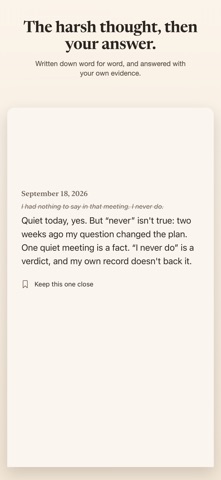
Selfworth makes the opposite bet. Every day, you write down one real thing you did. When a harsh thought shows up with the same old story, you answer it yourself, with what you wrote in front of you: things that actually happened, in your own words.
Your evidence has an advantage borrowed phrases never will: it already happened.
HOW A DAY WORKS
• Check in with yourself on a 1 to 7 scale
• Write one piece of evidence: something real you did, however small
• If you reacted differently today than you really want to, put what's behind it into words, rate how true it feels, and name the story it keeps telling
• Answer it fairly, with your evidence right there on the screen
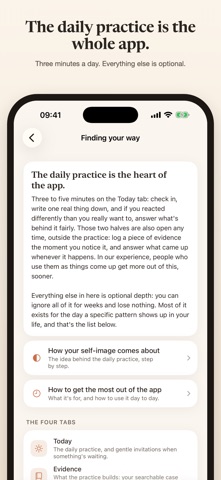
Three to five minutes. On a rough day the practice softens into a compassion break instead, and leaving early still counts.
THE METHOD
The daily loop follows cognitive behavioral therapy for self-esteem: keep a log of real positive evidence, then use it to give harsh thoughts a fair answer. Self-compassion carries the rough days. The studies behind this tested longer, often therapist-supported programs; Selfworth is a brief, self-guided adaptation, and the in-app science screen tells you plainly what the research shows and what it does not.
WHAT'S INSIDE
• The daily practice, with a fresh prompt every day
• The evidence book: searchable, and readable back like a quiet book of what you wrote
• Answers to what came up: everything you wrote down, next to your fair answer
• Experiments that put an untested rule like "If I say no, people will be angry with me" to a real-world test
• Programs for the patterns underneath: perfectionism, the worry loop, approval-seeking, procrastination shame, and more
• Deeper work: rewrite a painful memory at your own pace, make peace with a real mistake, build a kinder inner voice
• A weekly review, a monthly self-esteem check-in (the Rosenberg scale), and a personal blueprint for rough stretches
• Widgets, Siri shortcuts, and an optional daily reminder
BUILT FOR WEEKS THAT GO WRONG
No streaks, no badges. The weekly goal is 5 days out of 7, so one missed evening never wipes anything out.
WHAT IT COSTS
Everyone gets everything for the first 30 days. No card, nothing to cancel, and nothing is charged when they end.
After that, this stays free, permanently: your check-in and one line of evidence every day, at any mood, saved and counted toward your week. The compassion break and every rough-day support. Every word you have ever written, always readable. Your weekly review, your monthly self-esteem check, and your feeling chart. Every program to read and try on. One belief under test, and one memory-rewriting scene. Reminders, widgets, Face ID lock, and private iCloud backup.
The full app opens the rest: naming what an entry says about you, the whole exchange with what came up, the exercises inside most of the programs, more than one scene or experiment at a time, the weekly review's planning step, and the composed month and whole-record look-backs. Monthly, yearly, or once. Nothing you wrote is ever taken away.
PRIVATE BY DESIGN
There is no account to create, no analytics running, and no ads, ever. Your journal lives on your iPhone, behind an optional Face ID lock, with an optional backup to your private iCloud. The privacy label on this page reads "Data Not Collected" because there is nothing in the app that could send us your data.
THE HONEST FINE PRINT
There is research evidence this approach can work. That is not a promise that it will for you, and the app never pretends otherwise. Selfworth is not a medical device and is no substitute for professional care. If you ever need more than an app, it points you to real help.
And if it ever feels like a lot: the daily practice is the whole app. The rest can wait.
Terms of Use (EULA): https://www.apple.com/legal/internet-services/itunes/dev/stdeula/
Show more
Show less